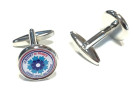
The hidden messages of cufflinks
You have surely spotted them on some men's outfits, on film costumes or at major events: cufflinks are the suit accessory par excellence.
If you thought cufflinks were fusty or old-fashioned, think again. Worn well, they let you assert your personal style on many occasions.
At a wedding, at work or every day, wearing cufflinks helps you stand out and sharpen your style.
But did you know they can also be used to send hidden messages? That is what this article is about.
The Édouard Philippe case
When it comes to secret messages sent through cufflinks, one name inevitably springs to mind in France: former French Prime Minister Édouard Philippe.
After his government resigned, Édouard Philippe gathered his team for a farewell drink. He was spotted wearing some rather unusual cufflinks…
The detail certainly did not go unnoticed: it went viral on social media. One of his close associates photographed the former Prime Minister wearing pink flip-flop cufflinks.
It was not the first time Édouard Philippe had used his cufflinks to make a point.
When Emmanuel Macron appointed him Prime Minister, he was already sporting a fine pair of Superman cufflinks.
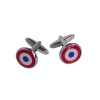
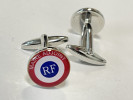
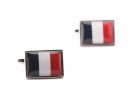
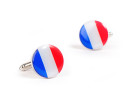
For his first evening news interview, he opted for blue, white and red cufflinks, in the colours of the French flag.
And on his return from a controversial trip to New Caledonia, he chose – to put out the fire – to wear cufflinks shaped like fire extinguishers.
As you can see, cufflinks can be very handy for subtly slipping in a message with a dash of humour.
The Ian Fleming case
A pair of mother-of-pearl cufflinks that belonged to the late Ian Fleming, creator of James Bond, and bearing what is thought to be a 007-style secret code, sold at auction for 5,700 euros.
Fleming, who died in 1964, is said to have worn the cufflinks at an after-party for the film Dr. No in 1962.
They were bought by an anonymous bidder at a jewellery and watch sale held by Mallams in Oxford.
They fetched several times their estimate: the top bid had originally been expected to reach 1,200 euros.
The buyer may well have been intrigued by the secret message on the back of the cufflinks, which are engraved “WUS”, “SIL”, “UDH” and “NUF”.
Louise Dennise, head of jewellery and watches at the auctioneers Mallams, said that even Fleming's own family did not know what the code meant.
In her view, it is a fantastic puzzle that has simply proved hard to crack. Perhaps only Fleming knew its meaning, or perhaps he meant to share it with just one person close to him.
Either way, Louise Dennise hopes that someone will one day manage to decipher it.
The different types of cufflinks
There are dozens of variations on the basic cufflink theme, and many alternative mechanisms. Here are the most common types of cufflinks for sending messages of your own:
Whale-back cufflinks
They have a straight post, a flat face and a “fish tail” toggle that flips completely flat against the post. This type of cufflink is very simple and easy to use, and probably the most common on the market.
Stud cufflinks
Stud cufflinks have no hinge or closing mechanism. Instead, they have a round face, a flat button and a straight post.
You put them in much like a classic shirt button: tilt the lower part sideways so that it sits at a 90-degree angle to the openings in your cuff, slip it through, then straighten it.
Once in place, they are perfectly secure. And with no moving parts, they are very durable.
Bullet-back cufflinks
They look like whale-back cufflinks, except that the post itself is made up of two parallel posts.
The closing mechanism is a narrow metal cylinder that nestles inside the frame – hence the name, since the cylinder looks like a bullet.