

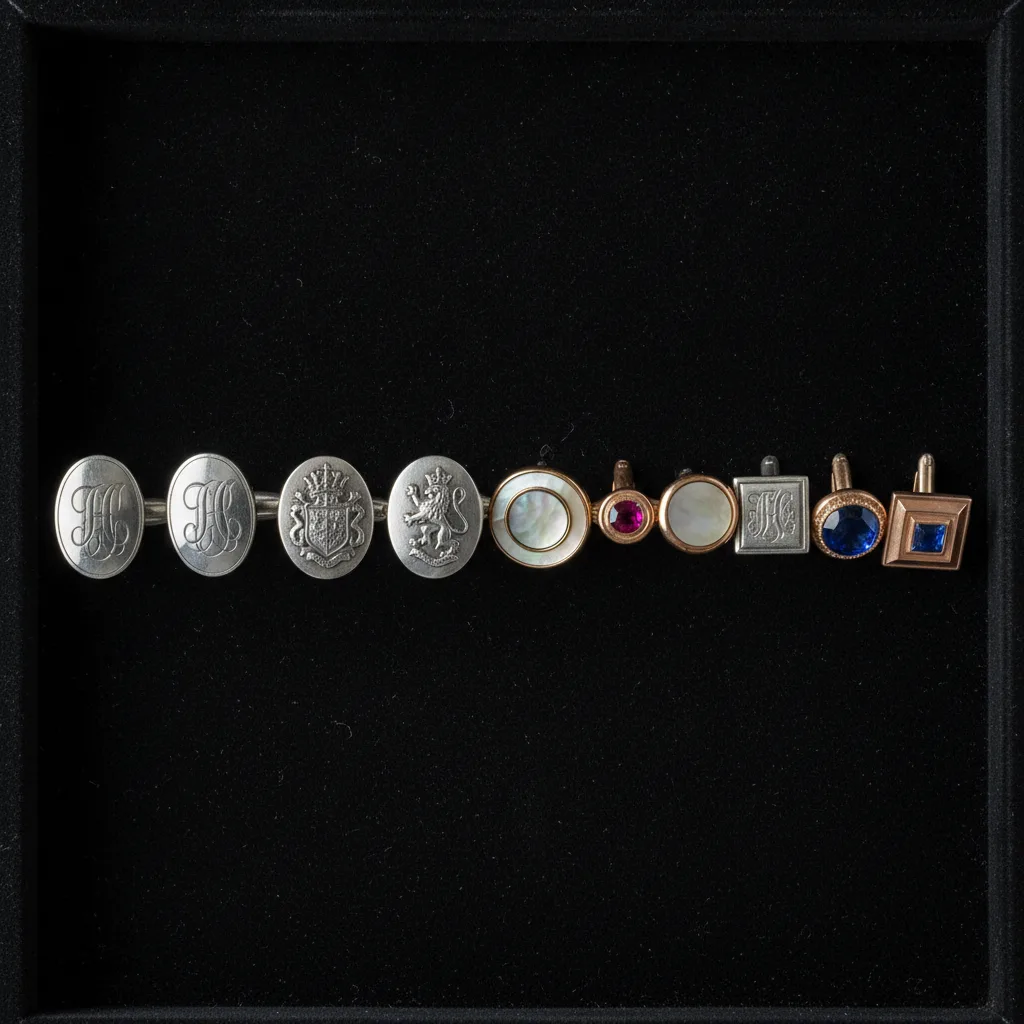
Some accessories pass through the centuries without losing an ounce of their prestige. Vintage cufflinks are among them. Born at the European courts of the 17th century, collected by the dandies of the 19th and brought back into fashion by the great jewellery houses in the 1990s, these small pieces of goldsmithing distil all the elegance of the formal male wardrobe.
Whether you are a lover of retro style, a seasoned collector or simply keen to take more care over how you dress, here is everything you need to know to hunt down, recognise, look after and wear antique cufflinks.
Vintage Cufflinks: A Collector's Buying Guide
Reading time: ~9 min
- A brief history of the cufflink
- How to recognise genuine vintage cufflinks
- The most sought-after styles among collectors
- How much is a pair of vintage cufflinks worth?
- Where to buy antique cufflinks in France
- How to care for antique silver cufflinks
- Which shirt to wear with vintage cufflinks
- The art of hunting for and wearing vintage well
- Frequently asked questions about vintage cufflinks
A brief history of the cufflink
The cufflink appeared in France in the 17th century, replacing the ribbons and lace that were then used to close shirt cuffs. Reserved for the elite, it was first made in gold or silver, sometimes embellished with precious stones or painted miniatures, and became a sign of wealth and refinement.
In the 18th century, materials diversified: mother-of-pearl, portrait miniatures and semi-precious stones enriched the repertoire of forms. It was in the 19th century that the accessory enjoyed its true golden age. Industrialisation made it more accessible and dandyism raised it to the rank of a marker of identity, while the lounge suit made it a central element of the male silhouette. This was also when the so-called T-bar mechanism appeared, a swivelling bar that remains one of the most common fastenings on antique pieces today.
At the start of the 20th century, the cufflink remained a staple of the formal male wardrobe, worn with the folded double cuff that English speakers call the French cuff and the French call the poignet mousquetaire. From the 1970s onwards, the spread of button-cuff shirts led to a gradual decline in its everyday use. The great fashion and jewellery houses brought it back into the spotlight in the 1990s, fuelling interest in vintage and collectable pieces at the same time.
How to recognise genuine vintage cufflinks
With reproductions and copies multiplying, knowing how to authenticate an antique piece is a valuable skill. Several clues can guide your judgement, even if you are no expert in men's jewellery.
Look at the patina of the metal
The patina of the metal is often the first indicator. Old silver shows natural oxidation in the recesses, a slightly greyish colouring that polishing products never remove completely. Vintage gold, for its part, sometimes reveals slight signs of wear on the edges, a sign of regular wear over several decades. Signed pieces, such as those bearing the signature of Cartier or other great houses, generally carry a carefully engraved hallmark consistent with the marking conventions of the stated period. A blurred, overly regular or badly positioned hallmark should ring alarm bells.
Examine the mechanism and the provenance
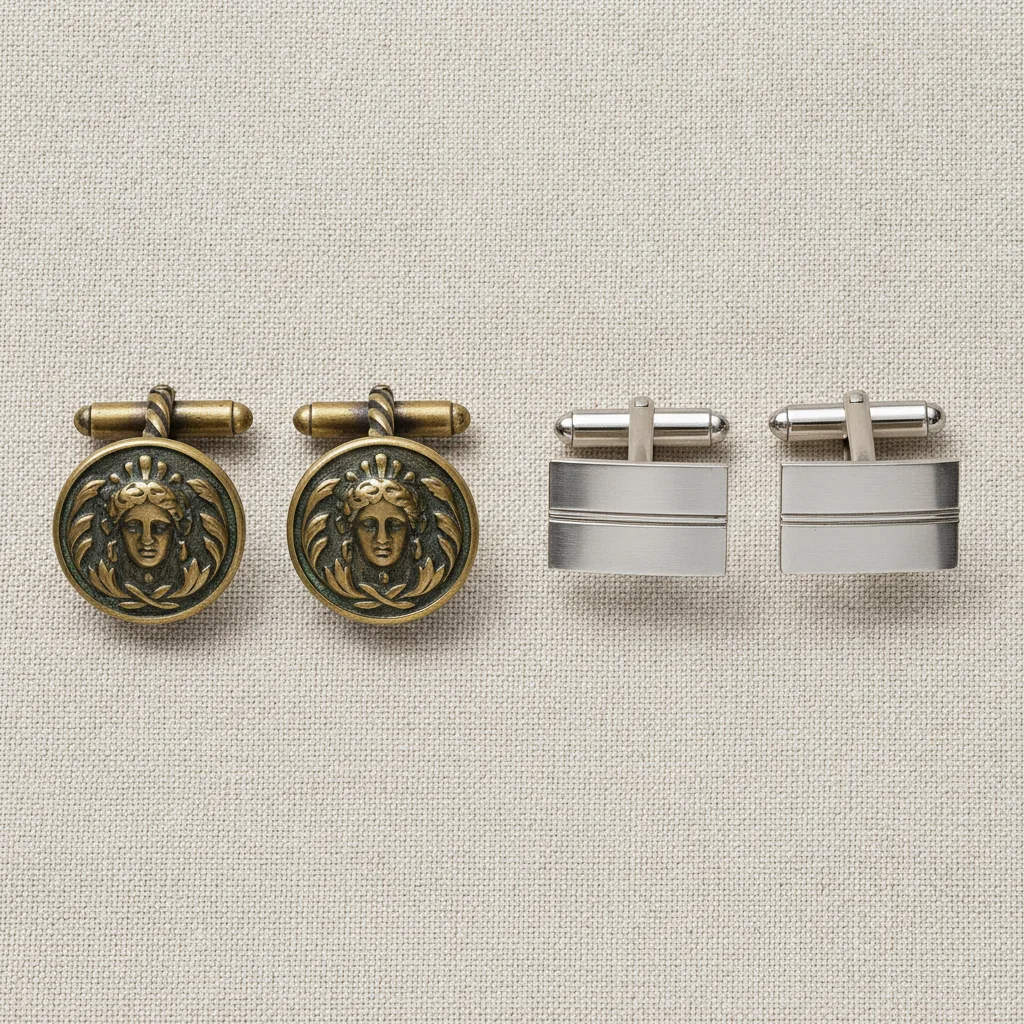
The mechanism itself tells you about the age of the piece. The swivelling T-bar, the chain linking two decorative faces or the fixed back with a stud are typical of 19th-century and early 20th-century designs. A mechanism that is too smooth, too uniform in its finish, may betray recent manufacture.
Finally, the provenance and authenticity of a piece are ideally confirmed by a detailed description, a period invoice or a certificate issued by an expert. Auction houses such as Maison Millon offer free valuation services, so that a professional can assess a piece before any purchase or resale.
The most sought-after styles among collectors
The market for antique cufflinks is organised around a few major aesthetic families, some of which attract particularly strong demand.
Art Deco designs
Art Deco designs from the 1920s and 1930s are among the most coveted. Their geometric motifs, their contrasts between onyx and gold, and their inlays of diamonds or guilloché enamel reflect the spirit of an era that knew how to combine modernity with understated luxury. Pieces signed by great jewellery houses, Cartier foremost among them, fetch high prices on the second-hand market and in the saleroom.
Personalised cufflinks
Antique silver cufflinks engraved with a monogram or a coat of arms form another highly prized category, particularly for their heritage value. These pieces tell a story: that of a man, a family, an era. Designs in mother-of-pearl, yellow gold or rose gold, sometimes set with rubies or sapphires, complete this overview of the pieces most sought after by collectors.
Good to know. Art Deco cufflinks are among the most highly valued on the collectors' market. A gold design with guilloché enamel or onyx, signed by a great house, can exceed several thousand euros at a specialist auction.
How much is a pair of vintage cufflinks worth?
The value of a pair of antique cufflinks depends on several factors: the metal, the presence of a signature, the general condition, the rarity of the design and the period of manufacture. According to figures published by Maison Millon, classic gold designs with no particular decoration or house signature generally sell for between 500 and 1,500 euros, while more common pieces, in plated metal or in silver without a maker's mark, tend to fetch around 100 euros. Exceptional pieces, signed and in remarkable condition, can reach much higher sums.
Here is an overview of the price ranges seen on the French second-hand market:
| Category | Materials | Indicative price range |
|---|---|---|
| Entry-level vintage | Plated metal, silver without a maker's mark | Around 100 euros |
| Mid-range | Solid gold or silver, no house signature | 500 to 1,500 euros |
| High end and collector's pieces | Gold, precious stones, enamel, signed pieces | Several thousand euros |
These ranges are indicative and may vary according to the condition of the piece, market conditions and recent auction results.
Where to buy antique cufflinks in France
The French second-hand market for men's jewellery is well organised. Several players offer pre-owned vintage cufflinks with detailed product listings stating the period, the alloy, the weight and the condition.
- Specialist platforms and online shops dedicated to signed pieces, with precise descriptions and high-definition photos.
- Auction houses such as Maison Millon, which regularly hold sales devoted to collectable jewellery and offer free online valuations.
- Bric-a-brac fairs, the Paris flea markets and local consignment shops, happy hunting grounds for patient enthusiasts.
Caution is called for, however, because without expertise it is easy to mistake a recent reproduction for a genuine antique piece.
Key point. Before buying at a market or a bric-a-brac fair, always check for a hallmark on the metal and test how smoothly the mechanism moves. A T-bar that no longer swivels freely or a bent post may indicate a damaged piece that is hard to restore without losing value.
How to care for antique silver cufflinks
Caring for antique cufflinks calls for regularity and a delicate touch, especially for silver pieces, which naturally tarnish on contact with the air.
Cleaning tips
- For precious metals: a non-abrasive cloth and warm water with a little mild soap are enough in most cases.
- For silver: a dedicated silver cleaner applied with a soft cloth combats tarnish without scratching the surface.
- For mother-of-pearl, stones or guilloché enamel: avoid knocks, sudden changes in temperature and any contact with chemicals, perfume or hairspray; a dry cloth is enough to dust them between wears.
- For storage: an individual case, such as those offered in dedicated gift sets, or a padded compartment in a jewellery box protects the pieces from scratches and knocks.
Storage and preservation
A dry environment, away from direct light, slows the tarnishing of silver and preserves the natural patina of old metals. If the mechanism is faulty, with a bent post or a loose T-bar, it is strongly advisable to entrust the piece to a jeweller or a workshop specialising in antique jewellery restoration rather than attempt a home repair. A clumsy intervention can permanently reduce the value of a collector's piece.
Which shirt to wear with vintage cufflinks
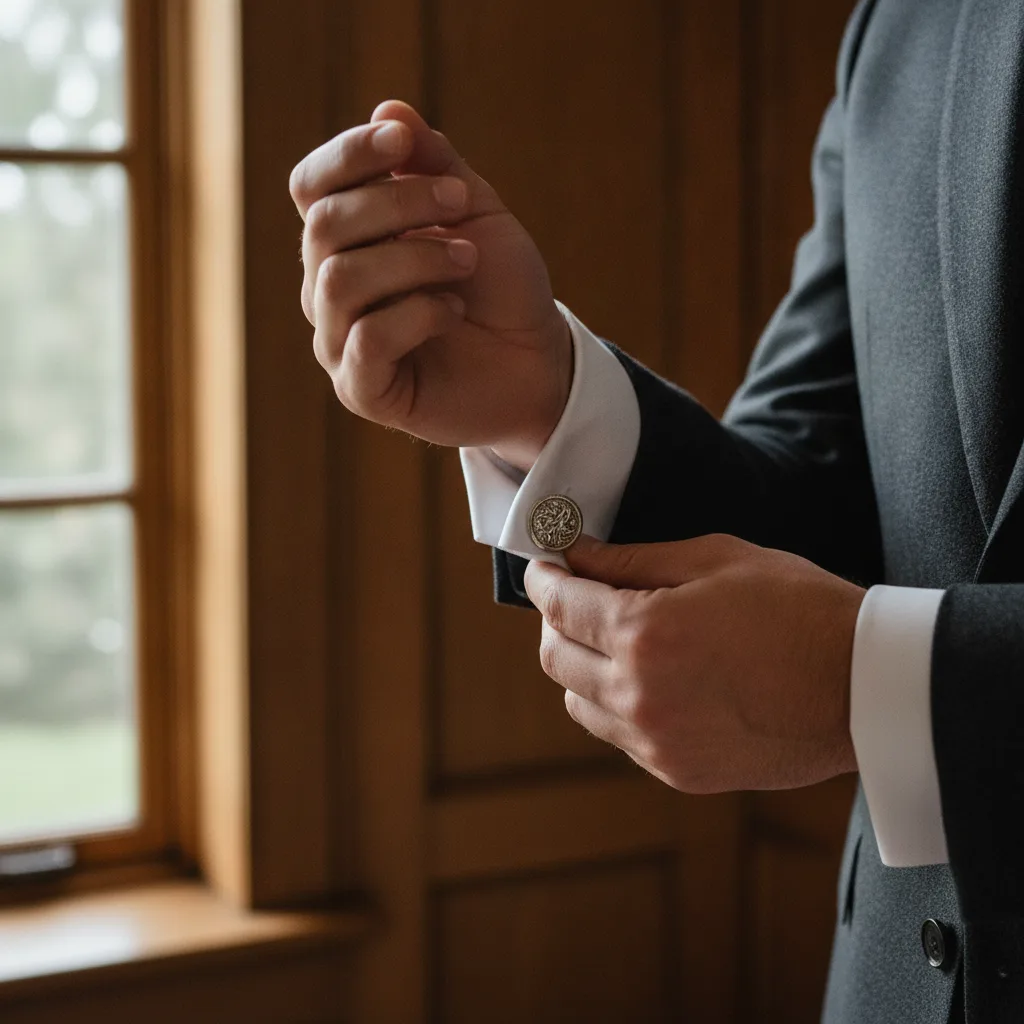
Cufflinks, whether antique or contemporary, are only compatible with a French-cuff shirt, that is, a double cuff folded back on itself and pierced with two buttonholes. This type of cuff, also called a double cuff in British menswear writing, is found on dress shirts, ceremonial shirts and some high-end town shirts.
For black tie or a wedding, vintage cufflinks in antique gold or silver naturally go with a white bib-front shirt and a dinner suit. In a professional setting or with a lounge suit, more understated designs, in patinated silver or with an engraved monogram, add a touch of personality without ostentation. The more graphic Art Deco designs pair well with blue or grey shirts, in settings where you want to assert a clear taste for retro style.
If you would like to discover new designs in this spirit of classic elegance, our selection of new arrivals and our best sellers offer pieces designed for lovers of well-crafted men's jewellery. For those who want to explore different aesthetics, our catalogue by colour and by shape makes it easy to search according to your stylistic preferences.
The art of hunting for and wearing vintage well
Hunting for vintage cufflinks is much more than a purchase: it is a connoisseur's pursuit, a way of reconnecting with a tradition of men's elegance that spans the centuries. Between the patina of old silver, the rigorous geometry of Art Deco motifs and the discretion of an engraved monogram, every pair tells a story.
Knowing how to recognise them, care for them and wear them well places you in a line of dandies who understood that understated luxury often lies in the details.
FAQ
What is the difference between a vintage cufflink and an antique cufflink?
The two terms are often used interchangeably, but there is a nuance. "Antique" generally refers to a piece more than a century old, an antique in the strict sense. "Vintage" is broader and applies to pieces from past decades, generally from the 19th to the mid-20th century, which are of stylistic or collectable interest without necessarily reaching the age required to be called antiques.
Can you get antique cufflinks valued free of charge in France?
Yes. Auction houses such as Maison Millon offer free valuation services online or in person. You generally just need to submit photos and a description of the piece to obtain an initial assessment by a jewellery expert. This is useful before a purchase or a resale, or to find out the value of a family heirloom.
Can vintage cufflinks be worn every day?
Yes, provided you choose sturdy pieces with a mechanism in good condition and pair them with French-cuff shirts. Designs in solid gold or silver without fragile stones are best suited to regular wear. It is advisable to take them off before washing your hands and to store them in a case after each use to keep them in good condition.
How can you tell whether a cufflink signed Cartier is genuine?
The authenticity of a signed piece rests on several verifiable elements: the quality and precision of the engraved hallmark, the consistency of the style with the stated period, and ideally original documentation (invoice, certificate, period case). If in doubt, it is advisable to have the piece appraised by a jeweller specialising in pre-owned jewellery or by an auction house before buying.
Which mechanisms are most often found on antique cufflinks?
Three types of mechanism dominate on vintage pieces. The swivelling T-bar, a crossbar that slides through the buttonhole and then locks by turning, is the most widespread on 19th-century and early 20th-century designs. The chain linking two decorative faces is another old form, more flexible but also more fragile. The fixed back with a stud or ball, simpler, is found on mid-range pieces or those of more recent make.