

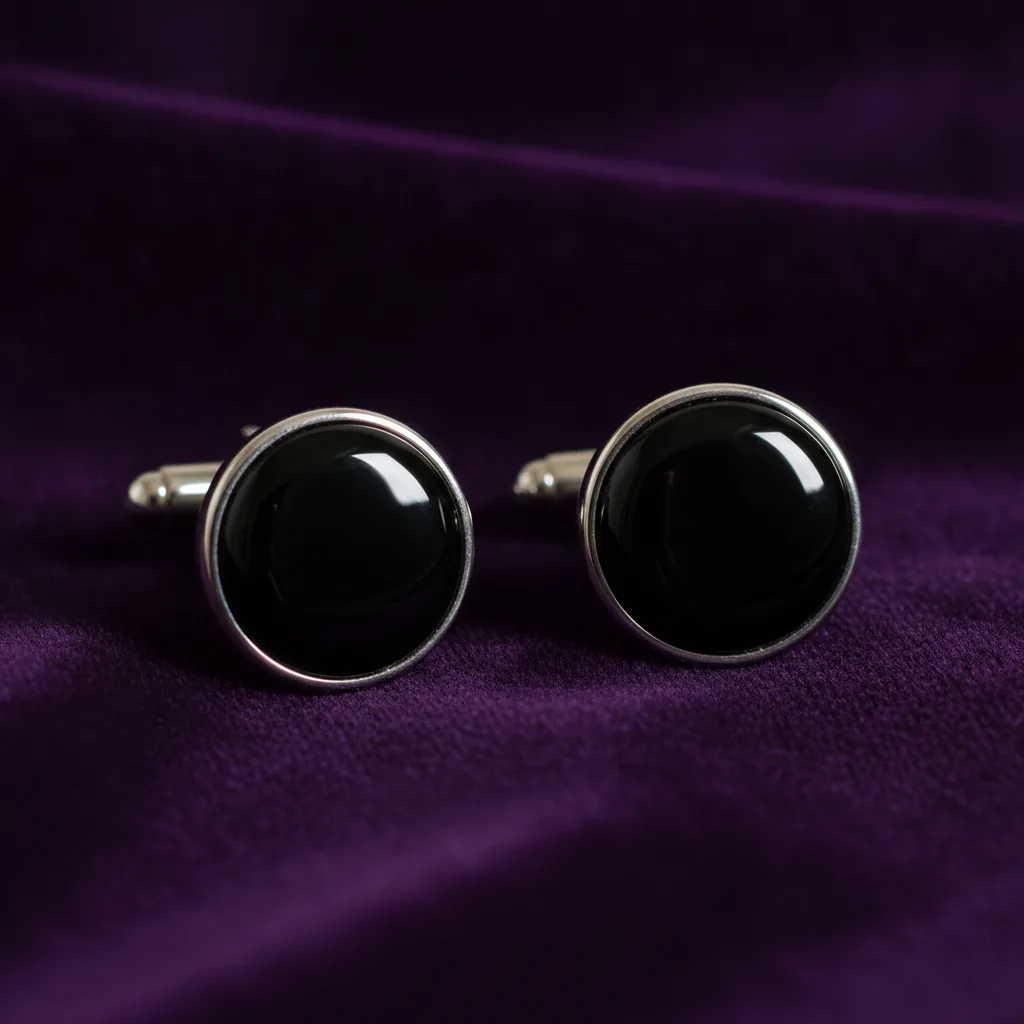
Some accessories do more than complete an outfit: they lift it. Onyx cufflinks belong to that rare category. A black stone with a glassy lustre, a silver or steel setting, a discreet bullet-back fastening: together they send a signal of elegance that anyone can read at a glance.
With a dinner suit, at a wedding or at a gala dinner, they feel right with a self-evidence that few other men's accessories can claim. This article walks you through the properties of onyx, the codes of black tie and the right habits for choosing, wearing and looking after your onyx cufflinks.
Onyx Cufflinks for Black Tie
Reading time: ~7 min
- What is onyx? Its properties and appeal in men's jewellery
- The codes of black tie and the place of onyx cufflinks
- How to choose quality onyx cufflinks
- How to wear onyx cufflinks
- Caring for onyx cufflinks and how long they last
- Going further with onyx cufflinks
- In short: why choose onyx cufflinks
- FAQ
- Onyx is a chalcedony (microcrystalline quartz, SiO₂) with a hardness of 6.5 to 7 on the Mohs scale, which makes it a sturdy stone well suited to men's jewellery.
- Onyx cufflinks are the benchmark choice for black tie: their deep black contrasts perfectly with a white shirt and a dinner suit.
- The onyx used in jewellery is frequently dyed to even out its colour, a standard and durable treatment recognised by gemmologists.
- Choosing onyx cufflinks well means assessing the quality of the stone, the setting and the type of fastening.
- Care is simple: clean with warm soapy water, store in a case and protect from knocks.
What is onyx? Its properties and appeal in men's jewellery
Definition and properties of onyx
Onyx is a variety of chalcedony, itself a microcrystalline form of quartz with the chemical formula SiO₂. Its hardness sits between 6.5 and 7 on the Mohs scale, which gives it good resistance to scratches and everyday wear. Its lustre is described as vitreous to waxy depending on the specimen, and its transparency ranges from translucent to opaque. It is in its opaque black form, polished as a cabochon, that it is most widely used in men's jewellery.
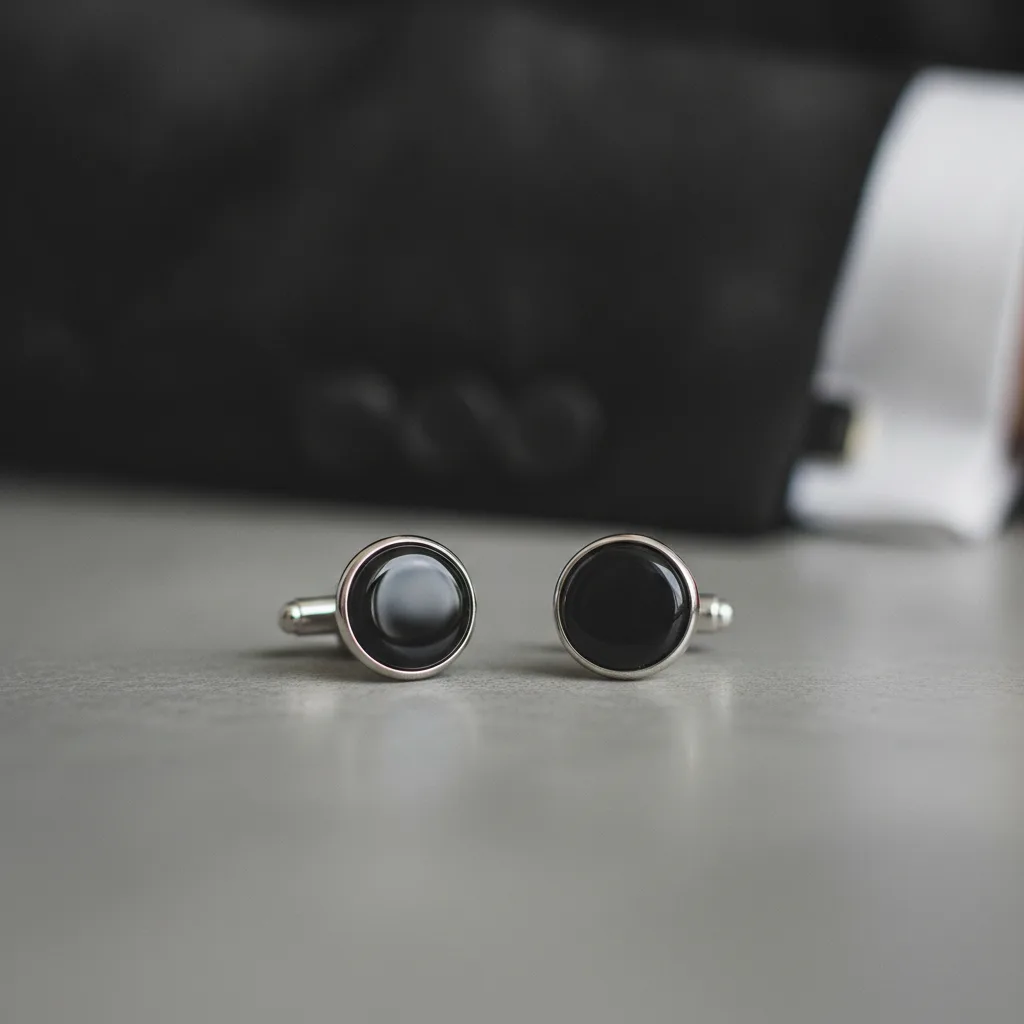
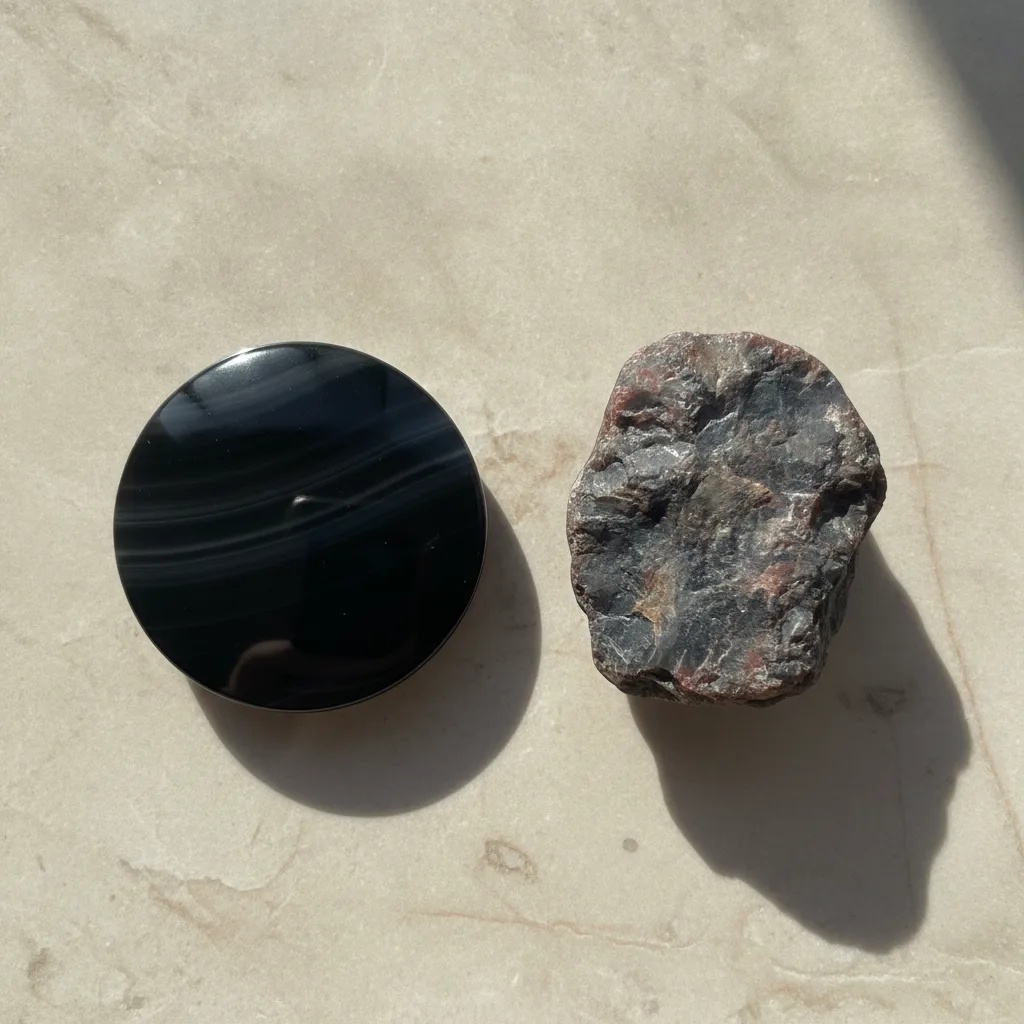
Onyx actually comes in several variants. The classic form shows parallel white and black bands. Sardonyx, for its part, combines reddish-brown tones with pale bands. For cufflinks, polished black onyx dominates the market, often set in silver, steel or palladium plate. Its smooth surface and deep black create a striking contrast with a white shirt.
It is worth noting that almost all the black onyx sold in jewellery has been dyed. This gemmological process involves impregnating the stone with a colouring solution to obtain an even, intense black. Specialists, including the International Gem Society (IGS), regard it as a standard and durable treatment. It does not reduce the stone's practical value, but you should be told about it when you buy.
Good to know
The Gemological Institute of America (GIA) and the International Gem Society (IGS) point out that dyeing onyx is a common and durable gemmological treatment. A reputable seller will mention it without being asked.
The codes of black tie and the place of onyx cufflinks
Black tie is a formal dress code for gala dinners, smart weddings, award ceremonies and official functions. It rests on a few unchanging pillars: the dinner suit (jacket with silk-faced lapels, trousers with a side stripe), a white dress shirt with a bib or pleated front, a black bow tie and patent leather shoes. Within this ensemble, cufflinks are no mere detail. They are visible with every gesture and every handshake, and they contribute directly to the visual coherence of the outfit.
Where onyx cufflinks fit in
The shirt worn with a dinner suit is necessarily a shirt with French cuffs, also known as double cuffs. This type of cuff is wider and stiffer than a standard cuff, and it can only be fastened with cufflinks. There is therefore no alternative: choosing a dinner suit means choosing cufflinks. And in that context, black onyx stands out as the stone most in keeping with the black tie aesthetic.
Its deep black echoes the bow tie, the silk lapels and the stripe on the trousers. Its polished surface catches the light without scattering it showily, which is exactly the spirit of black tie: a restrained, controlled elegance that has no need to announce itself loudly. A black onyx cabochon set in silver or palladium plate gives an effect that is both classic and contemporary, timeless in the best sense of the word.
How to choose quality onyx cufflinks
The quality criteria to examine
Choosing onyx cufflinks means assessing three separate elements: the stone itself, the setting and the fastening mechanism.
For the stone, the points to look at are the depth of the black, the evenness of the colour across the whole cabochon, the absence of visible cracks and the quality of the polish. Good onyx has a perfectly smooth surface, with no micro-chips or irregular matt patches. The difference between untreated natural onyx and dyed onyx is hard to see with the naked eye, but a gemmologist can establish it. Either way, the visual result is identical and the durability comparable.
For the setting, the most common options are solid sterling silver (925), stainless steel, gold plate and palladium plate. Solid silver offers the best balance between a noble material and an accessible price. Palladium plate, which resists tarnishing better, suits wearers who want minimal upkeep. The setting should be clean, with no burrs, and the stone should be held firmly with no play.
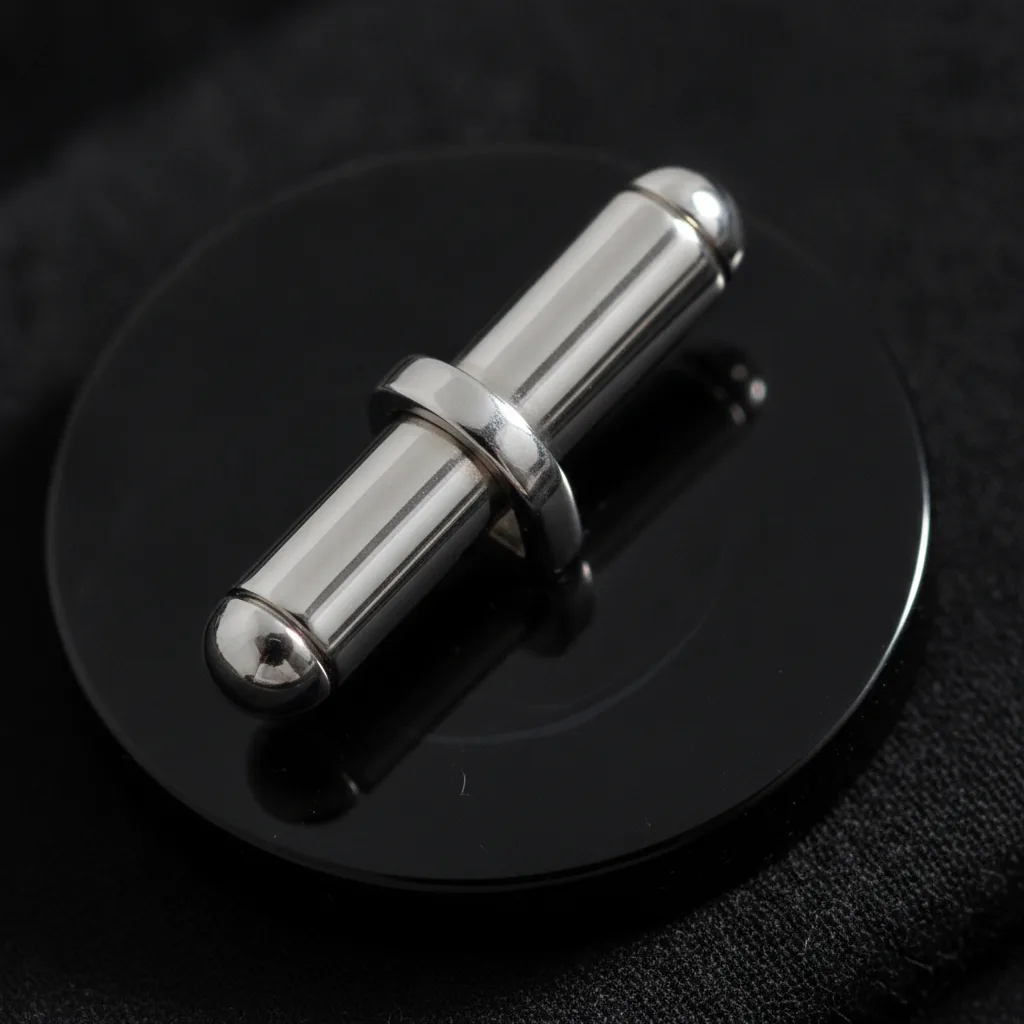
Finally, the fastening mechanism determines how easy they are to use day to day. The bullet-back fastening (a torpedo-shaped swivel bar) is the most widespread and the most practical. It slips easily through the buttonholes of a French cuff and locks with a quarter turn.
| Criterion | Entry level | Mid-range | High end |
|---|---|---|---|
| Stone | Dyed onyx, standard finish | Dyed onyx, careful polish | Selected onyx, hand-cut cabochon |
| Setting | Plated metal (brass) | Steel or palladium plate | Solid 925 silver or gold |
| Fastening | Basic bullet back | Reinforced bullet back | Precision hinged mechanism |
| Indicative budget | 20 to 50 euros | 50 to 150 euros | 150 euros and above |
How to wear onyx cufflinks
The basic rule is simple: onyx cufflinks only work with a French-cuff shirt. This type of shirt, whose cuff folds back on itself and is held by two overlapping buttonholes, is an absolute prerequisite. A single-cuff shirt, however good its quality, cannot take cufflinks.
For black tie, the canonical combination pairs a white dress shirt with a bib or pleated front, a black or midnight-blue dinner suit, a black bow tie and onyx cufflinks in a silver-tone setting. It works because it relies on a palette reduced to two colours, black and white, in which each element reinforces the others.
Outside strict black tie, onyx cufflinks go very well with a charcoal or black suit, a white or light blue shirt and a plain silk tie. They suit formal weddings, important business dinners and ceremonies. As for accessories, complete the look consistently with:
- a watch on a black leather strap or a steel bracelet
- a black leather belt
- patent or plain calf Oxford shoes
At autrepairedemanches.fr we offer a selection of cufflinks in stone and other fine materials, available in our new arrivals section and sorted by colour to make it easier to choose according to your outfit. Our best sellers also give you a good idea of the designs our customers like most.
Caring for onyx cufflinks and how long they last
With a hardness of 6.5 to 7 on the Mohs scale, onyx is tough enough for regular wear. It is harder than most common metals, but softer than sapphire (9) or diamond (10). This means it can be scratched by harder stones or abrasive surfaces, and it should be protected from heavy knocks that could chip or crack it.
Good care practice is as follows. For cleaning, a soft cloth lightly dampened with warm soapy water is all you need. Avoid harsh chemicals, ultrasonic cleaners and steam, which can affect the dye or weaken the setting. After cleaning, dry the cufflinks carefully with a non-abrasive cloth before putting them away.
For storage, an individual case or a fabric pouch is recommended, to avoid contact with other jewellery or harder stones. It is also wise to check from time to time that the stone is still held securely in its setting, especially after an accidental knock.
If you wear your onyx cufflinks regularly, they can last for decades with no visible deterioration, provided you follow these basic precautions. Onyx is a semi-precious stone, not a fragile material, and its longevity in men's jewellery is well established.
Key point
Always store your onyx cufflinks in a separate case. Contact with a harder stone, such as a diamond or a ruby, can scratch the polished surface of the onyx and dull its characteristic glassy lustre.
Going further with onyx cufflinks
Onyx cufflinks are one of the most coherent choices you can make for a black tie outfit or a formal occasion. Their deep black, their controlled lustre and their natural compatibility with the dinner suit make them a piece of men's jewellery that outlasts seasons and trends without ever looking dated.
Understanding the nature of the stone, the quality criteria and the right care habits lets you buy with discernment and enjoy this accessory for a long time. To explore our selection, visit autrepairedemanches.fr and browse our cufflinks by shape, or discover our gift sets to give a complete ensemble.
In short: why choose onyx cufflinks
All in all, onyx cufflinks combine a robust semi-precious stone, a deep black ideal for black tie and simple care, which makes them a lasting investment for any formal wardrobe.
Once you master the selection criteria (quality of the onyx, setting, fastening) and a few rules for wearing and care, you have a discreet but defining accessory, able to accompany a dinner suit as well as a formal lounge suit for many years to come.
FAQ
What is the difference between natural onyx and dyed onyx?
Naturally even black onyx is rare in its raw state. The vast majority of stones sold as black onyx have been dyed to even out their colour. This treatment is permanent, recognised by gemmologists and does not affect the stone's durability. To the naked eye, it is practically impossible to tell natural onyx from dyed onyx without laboratory analysis.
Can you wear onyx cufflinks with a coloured shirt?
Yes, black onyx pairs well with shirts in understated colours such as light blue, pearl grey or off-white. For strict black tie, however, the white shirt remains the absolute reference. With patterned or brightly coloured shirts, the contrast can become less legible and the elegant effect is diluted.
Are onyx cufflinks suitable for a daytime wedding?
Yes, provided the dress code is formal or semi-formal. For a daytime wedding with a dark suit and white shirt, they fit in perfectly. For an outdoor wedding with a more relaxed dress code, cufflinks in a lighter material (mother-of-pearl, coloured enamel) may suit the setting better.
How can I tell whether the setting of my onyx cufflinks is solid silver?
A hallmark stamped on the setting indicates the silver content. The 925 mark corresponds to sterling silver (92.5% pure silver), the most common standard in jewellery. If there is no visible mark, ask the seller for a product sheet or a certificate of materials.
Are there onyx cufflinks for a tight budget?
Yes. Designs with a plated metal setting and dyed onyx are available from around twenty euros. They offer the same look as high-end versions, with slightly lower durability over the long term. For occasional wear (weddings, ceremonies), they are a perfectly reasonable choice.