


Past 40, style is no longer just about the cut of your suit or the price of your watch. What makes the difference is the details that tell people who you are. Properly matching your cufflinks to your watch, your tie and your suit turns a decent outfit into a truly polished look.
In this guide, you'll see how to match your cufflinks by taking colours, materials and the level of formality into account. The goal isn't to dress you up in a costume, but to give you a clear set of instructions so that every cufflink you wear reinforces your elegance, at the office as much as at a wedding.
The Art of Matching Your Cufflinks: Watch, Tie and Suit
Reading time: ~10 min
- Essential reminder: when to wear cufflinks
- The golden rules for matching your cufflinks
- Matching cufflinks and your watch
- Matching cufflinks, tie, bow tie and suit
- Playing with other accessories
- Choosing by occasion: formal, business or smart-casual
- Practical guide: putting on your cufflinks
- Do's and don'ts
- FAQ
Essential reminder: when to wear cufflinks
Cufflinks are designed for shirts with French cuffs (double cuffs, folded back on themselves); they therefore belong to a dressed-up register.
Polished business wear: a dress shirt, a client meeting, an important presentation. Cufflinks add authority and refinement.
Weddings, galas, ceremonies: a three-piece suit or a tuxedo, a tie or bow tie. Cufflinks are part of the classic dress code; visual consistency is the priority.
Smart-casual: a French-cuff shirt with no tie, a blazer or raw denim. Cufflinks become a knowing nod, as long as they match your watch and accessories.
The golden rules for matching your cufflinks
Start with the shirt
White shirt: almost anything works; silver or gold, possibly echoing your tie or pocket square.
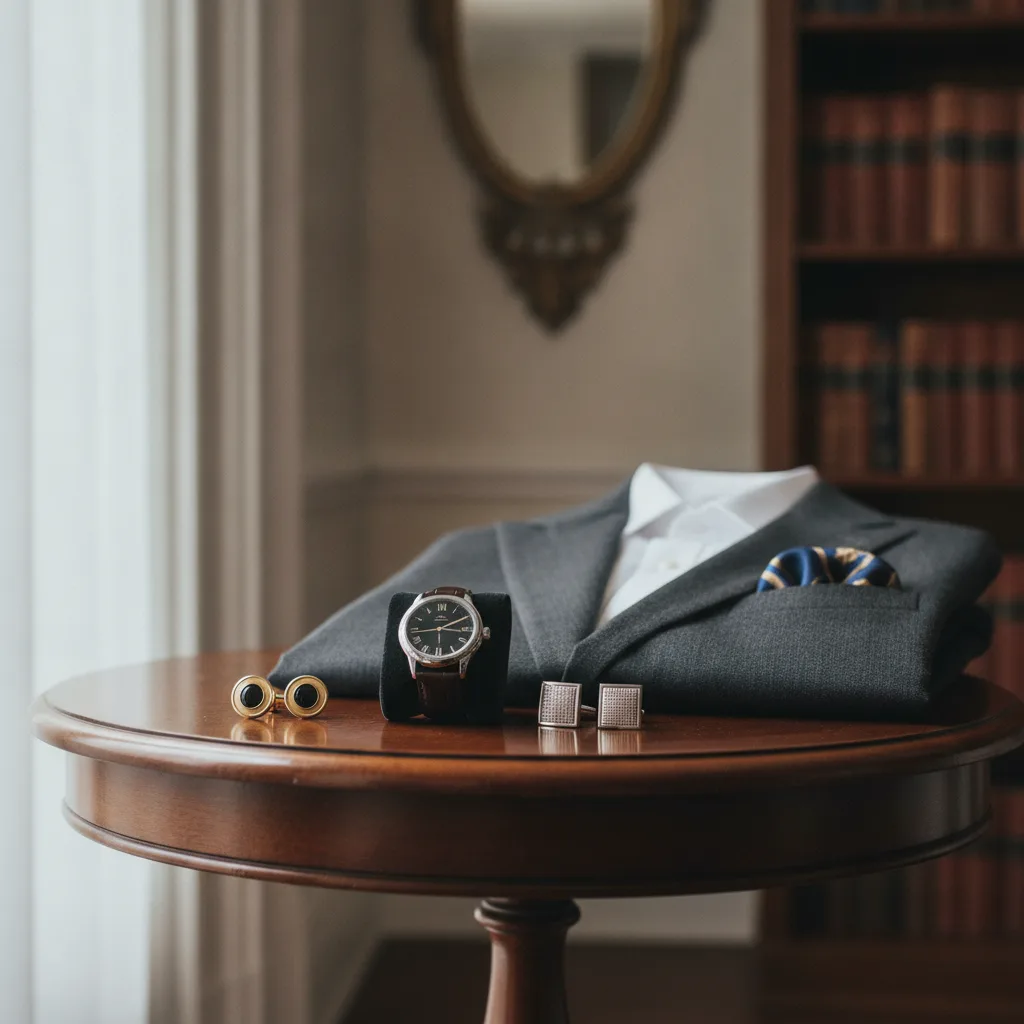
Light blue shirt: stunning with silver, a darker blue, midnight blue, or a discreet complementary touch (orange, amber, warm brown).
Striped or small-patterned shirt: favour understated cufflinks; the cuff shouldn't compete with the pattern.
Three simple colour strategies
1. Tone on tone: the same colour family, for example a sky-blue shirt with navy cufflinks, for a discreet, chic result.
2. Analogous colours: neighbouring shades (blue-green, blue-purple, burgundy-pink). Example: a navy suit, a deep green tie, green or petrol-blue cufflinks.
3. Controlled complementary colours: opposites on the colour wheel (blue-orange, red-green...). For example: a midnight-blue suit, a dark blue tie, silver cufflinks with an amber detail. Remember that a silver pair goes with almost anything.
Matching cufflinks and your watch
Matching your metals
Steel or silver-tone watch: silver, polished steel or rhodium-plated cufflinks; a small touch of colour is possible.
Yellow-gold or rose-gold watch: gold or gold-tone cufflinks; create a consistent trio if you also wear a ring.
Two-tone watch: take your cue from the dominant metal, usually steel, to avoid overloading the look.
Watch style and cufflink style
Dress watch: slim cufflinks, smooth metal, a discreet cabochon.
Sports watch: bolder cufflinks, a brushed texture or a strong geometric shape.
Collector's watch: understated cufflinks, of equivalent quality but visually more restrained.
Matching cufflinks, tie, bow tie and suit
With your suit
| Suit | Shirt | Recommended cufflinks |
|---|---|---|
| Navy | White | Smooth silver, dark blue, white mother-of-pearl |
| Mid grey | White or blue | Silver, black onyx, understated burgundy |
| Black or tuxedo | White | Silver, black onyx, mother-of-pearl (no loud colours) |
| Light blue | White or blue | Silver, navy, tone-on-tone patterns |
| Beige / sand | White | Gold, gold-tone, brown, amber, ivory mother-of-pearl |
With your tie
Direct echo: the dominant colour of the cufflinks matches that of the tie (e.g. a burgundy tie / a burgundy insert on silver cufflinks).
Secondary echo: the cufflinks pick up a secondary colour from the tie (e.g. a blue tie with tiny burgundy motifs / burgundy cufflinks on silver metal).
With your bow tie
For weddings, you can choose cufflinks covered in the same fabric as the bow tie, or at least a very close shade within the same colour family.
With your pocket square
If the tie is bold, keep the pocket square more understated and use the cufflinks for a discreet echo of colour.
Playing with other accessories
Belt: match the metal of the buckle to that of your cufflinks.
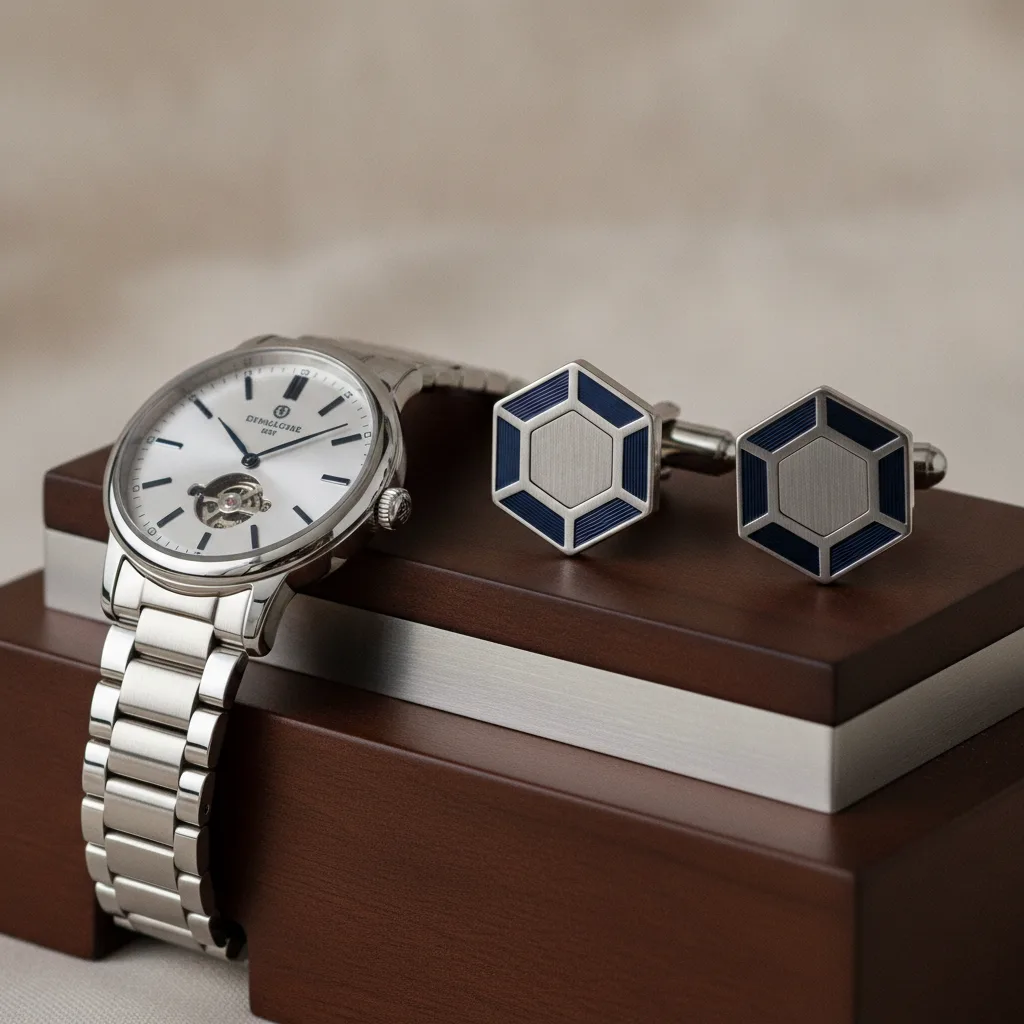
Braces: if any metal parts are visible, keep the same tone; the strap can echo the cufflink insert.
Socks: a hidden but elegant detail; the colour can be echoed in your cufflinks (royal blue, burgundy, bottle green).
Choosing by occasion: formal, business or smart-casual
Weddings, galas, tuxedos
Go for smooth metal (gold or silver), mother-of-pearl or onyx, simple shapes, and avoid any bright colours.
Business wear and professional meetings
Favour silver-tone or steel metal, colour details coordinated with your tie, understated geometric shapes and classic tones (blue, burgundy, black).
Casual or creative occasions
Dare to wear coloured cufflinks, original patterns or printed fabric, as long as the rest of your outfit stays understated and true to your personality.
Practical guide: putting on your cufflinks
- Check that the shirt has French cuffs.
- Fully unfold the cuff.
- Fold the sleeve back on itself to line up the four layers and the buttonholes.
- Pass the cufflink post through the four holes.
- Lock the mechanism (fish-tail, stud, ball-back) or straighten the moving part.
Tip: fasten your cufflinks before putting the shirt on, to save time.
Do's and don'ts
Do: match the metal of your cufflinks to your watch, use your cufflinks as a subtle echo of colour, favour quality, and adjust how much flair you show to the dress code.
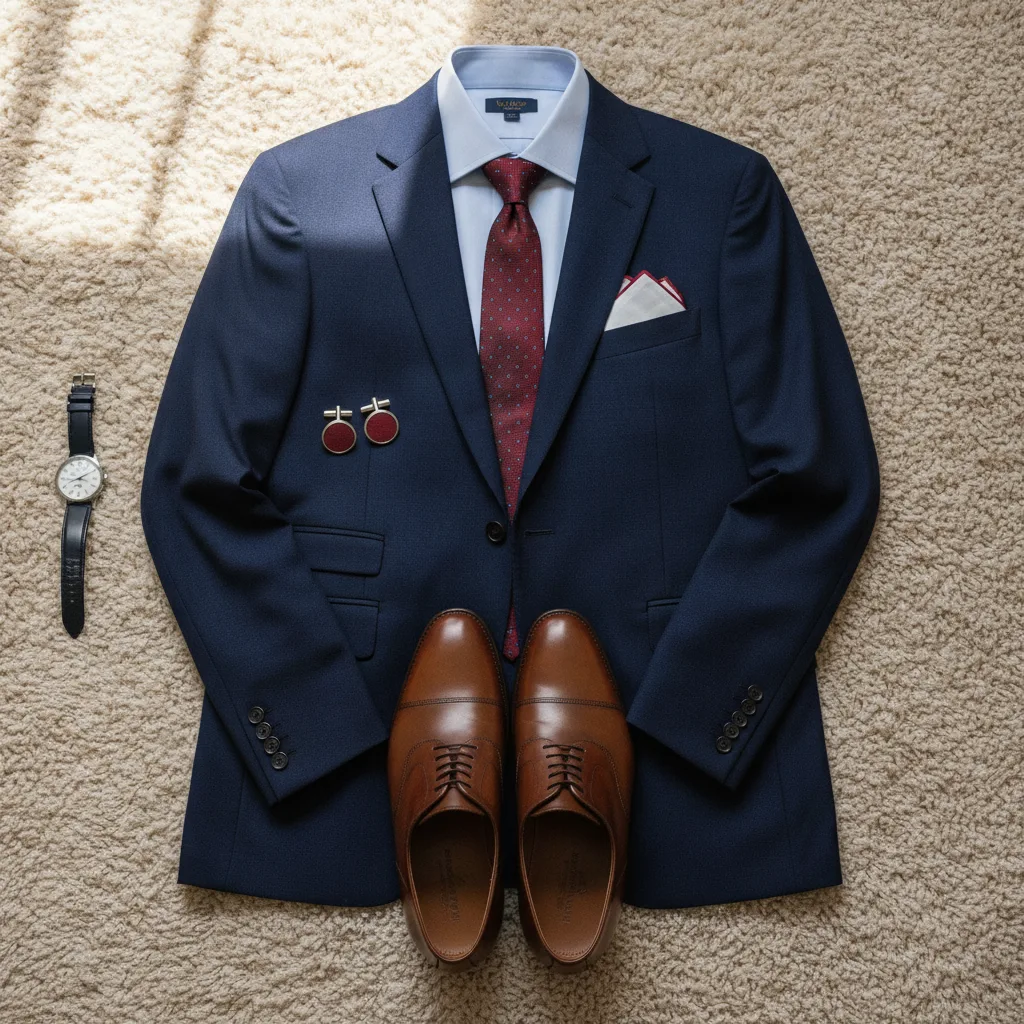
Don't: mix gold and silver at random, choose loud colours with a dark suit, wear flashy patterns in a formal setting, or let your cufflinks become the focal point of your outfit.
FAQ
How do you get started with cufflinks?
Invest in one simple silver pair and one in black onyx or midnight blue. Always match the metal to that of your watch; with a white or light blue shirt and a blue or grey suit, you'll get it right 99% of the time.
Can you wear cufflinks without a tie?
Yes, as long as the rest of the outfit is well put together: a French-cuff shirt, a well-cut blazer, and raw denim or suit trousers. Avoid overly formal designs (very glossy mother-of-pearl, imposing stones).
How many pairs of cufflinks should you own?
Three to five is enough: 1) a smooth silver pair, 2) a dark pair (black onyx or midnight blue), 3) a warm pair (gold or gold-tone), 4) possibly a fabric pair to match your bow tie, 5) a creative pair for informal occasions.
Mastering the art of matching your cufflinks to your watch, tie and suit means accepting that elegance is played out in the details. To discover designs built for this level of care, explore the high-end cufflinks from Une Autre Paire De Manche.
Summary: matching your cufflinks well, day to day
By taking your shirt, suit, watch and other accessories into account, you create a coherent whole where every detail reinforces your look rather than scattering it. Rely on a few simple rules — matching metals, subtle echoes of colour, a level of formality suited to the occasion — to turn your cufflinks into a well-judged distinctive touch rather than a gratuitous style statement. With a few well-chosen pairs, you'll cover most of your professional, ceremonial or smart-casual situations, while staying true to your personality.