

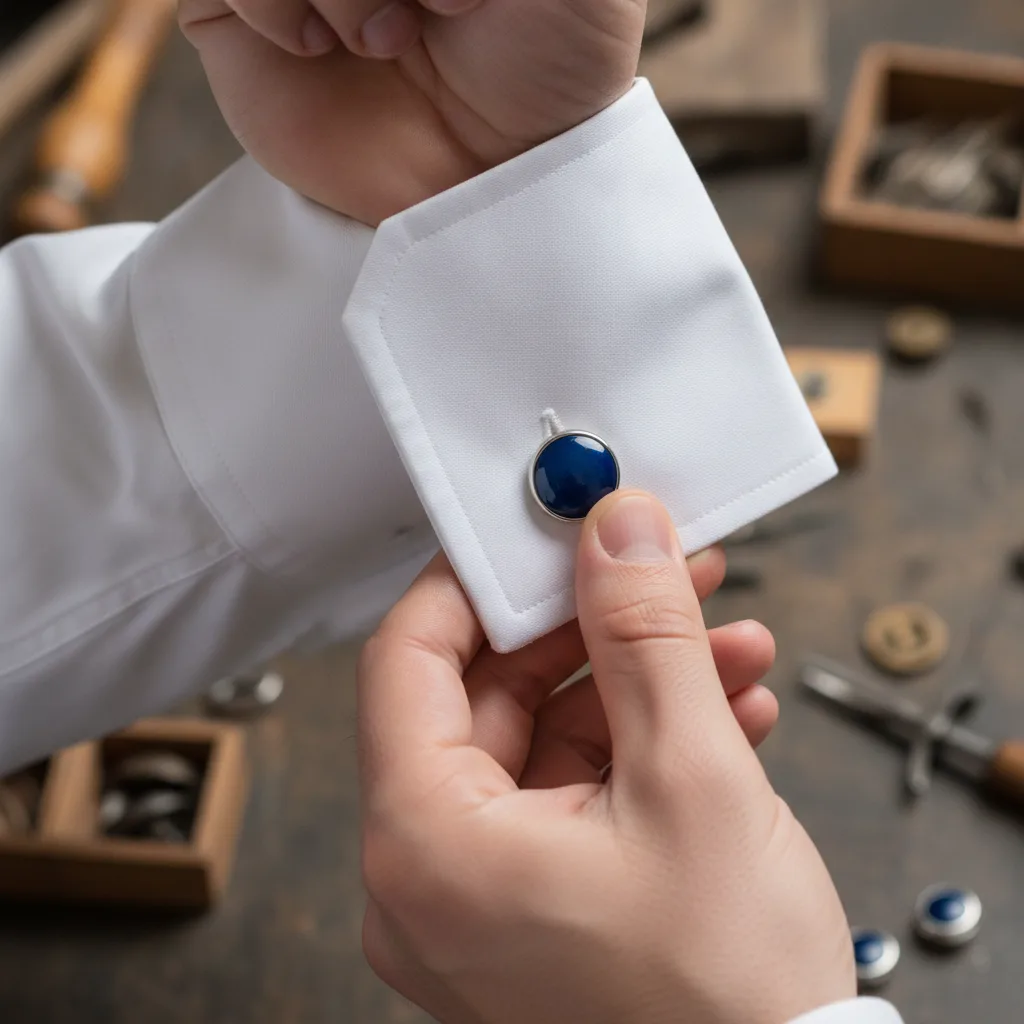
A neatly fastened cuff often says more than a tie. Among all men's accessories, enamel cufflinks hold a special place, at the crossroads of jewellery and traditional craftsmanship. Behind their colourful surface lies an ancient process, fusing powdered glass onto a metal base, which demands precision, carefully controlled firing and patient polishing.
At Une Autre Paire de Manches, many customers want to understand what they are wearing before they buy. This complete guide explains how enamel is made, and how to choose it, wear it and look after it without damaging it.
Enamel Cufflinks: The Complete Guide
Reading time: ~9 min
- What are enamel cufflinks?
- How are enamel cufflinks made?
- Soft or hard enamel: which should you choose?
- Is enamel fragile in everyday use?
- How to wear enamel cufflinks
- Choosing your pair: the criteria to check
- Personalised enamel cufflinks, gifts and weddings
- How to clean enamel cufflinks
- Enamel, a choice with character for your cuffs
- FAQ
What are enamel cufflinks?
Composition and structure of an enamel cufflink
An enamel cufflink consists of a metal base covered with a coloured vitreous coating. Work published by Oxford Academic on the history and techniques of enamel in jewellery gives a simple definition: enamel is essentially glass fused onto a metal support, coloured mainly by metal oxides. So this material is neither paint nor resin. It is fired, bonded into the surface, and keeps its colour over time far better than a varnish applied cold.
The base may be brass, stainless steel, silver or plated metal. This choice affects the weight you feel on the cuff, the resistance to tarnishing and the final price. Then comes the fastening, the system that holds everything in the buttonhole, the most common being the whale-back, followed by the toggle, the chain and the straight bar. A smooth fastening that swivels without excessive play remains a good indicator of the quality of assembly.
How are enamel cufflinks made?
The main manufacturing stages
The enamelling process described in the Journal of Chemical Technology and Metallurgy involves melting a glass powder onto the surface of a metal substrate within a specific temperature range. In the workshop, this operation is part of a sequence of steps that calls for method. The base is cut or cast, the partitions or cavities that will hold the colour are created, the enamel is applied and then goes into the kiln. Several successive firings are often needed to achieve a dense, even area of colour.
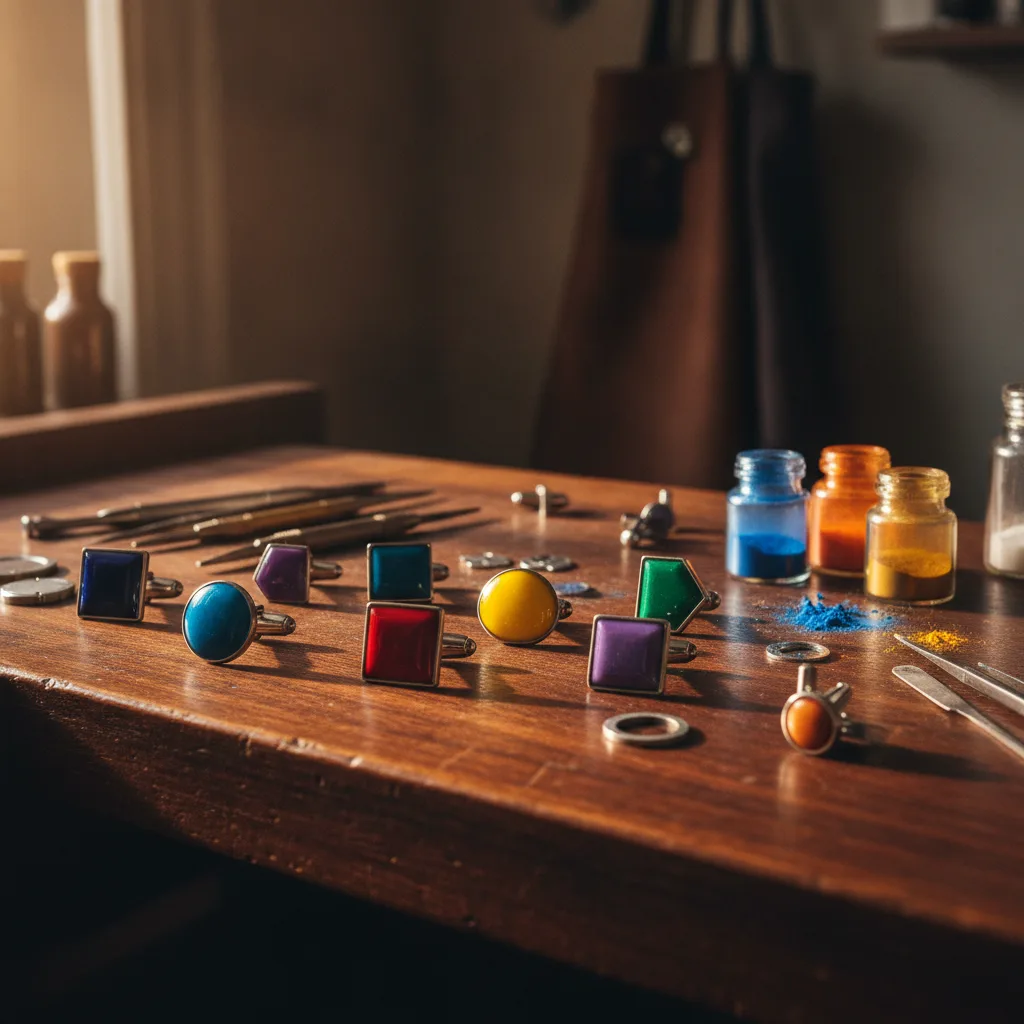
Next comes polishing, the stage that gives the vitreous coating its glossy finish or, depending on the treatment, a more discreet matt finish. Setting a stone where required, engraving a monogram and fitting the fastening complete the process. The cloisonné technique, in which fine metal strips separate each colour, shows the precision required well, as each cell must be filled to the right height before firing. It is this level of exacting work that sets hand-crafted enamel cufflinks apart from a simply printed piece, and that explains the Entreprise du Patrimoine Vivant label (the French "Living Heritage Company" award) granted to certain French workshops.
Soft or hard enamel: which should you choose?
Differences in appearance between soft and hard enamel
This is the first question to ask before buying. The two families give very different results, even with an identical design. Soft enamel is poured into the cavities of the metal base; its surface sits slightly recessed and the metal outlines remain visible. Hard enamel is fused and then polished until it is flush with the metal, giving a smooth, uniform surface close to a fine jewellery finish.
| Criterion | Soft enamel | Hard enamel |
|---|---|---|
| Surface appearance | Slightly recessed, textured | Smooth, flush |
| Metal outlines | Clearly visible | Barely noticeable after polishing |
| Finish | Graphic, decorative | Glossy and even |
| Preferred use | Logos, colourful designs, personalisation | Dressy pieces, premium finish |
| Impression | Crafted and expressive | Understated and refined |
Be aware, however, that these two terms are not used in the same way by every manufacturer. Before ordering, ask for the exact type of enamel, the base material, the firing process, whether there is any varnish or plating, and the care recommendations. A reputable brand will answer these questions straightforwardly.
Is enamel fragile in everyday use?
Enamel is a vitreous material, so it needs to be treated as such, without turning it into a display-cabinet object. A review published by Springer on the durability of vitreous enamel coatings points out that their performance depends on resistance to abrasion, chemicals and corrosion, and that this varies with composition, thickness and firing. In other words, well-fired enamel on a sound base copes very well with regular use.
The real risks lie elsewhere. A drop onto a tiled floor, repeated rubbing against a watch strap or a bunch of keys, contact with chlorine or perfume sprayed directly onto the piece: these are what cause a chip or tarnish the metal. Storing each pair separately in a soft pouch or a compartmentalised box removes most of these risks.
Good to know
Take your cufflinks off before sport, swimming or a long hand wash. Moisture trapped in the fastening wears the piece more than daily wear itself.
How to wear enamel cufflinks
They are worn with a shirt with French cuffs, also known as double cuffs. This cuff has no sewn-on button, but two aligned buttonholes designed for the accessory to pass through. Some convertible cuffs also take a cufflink.
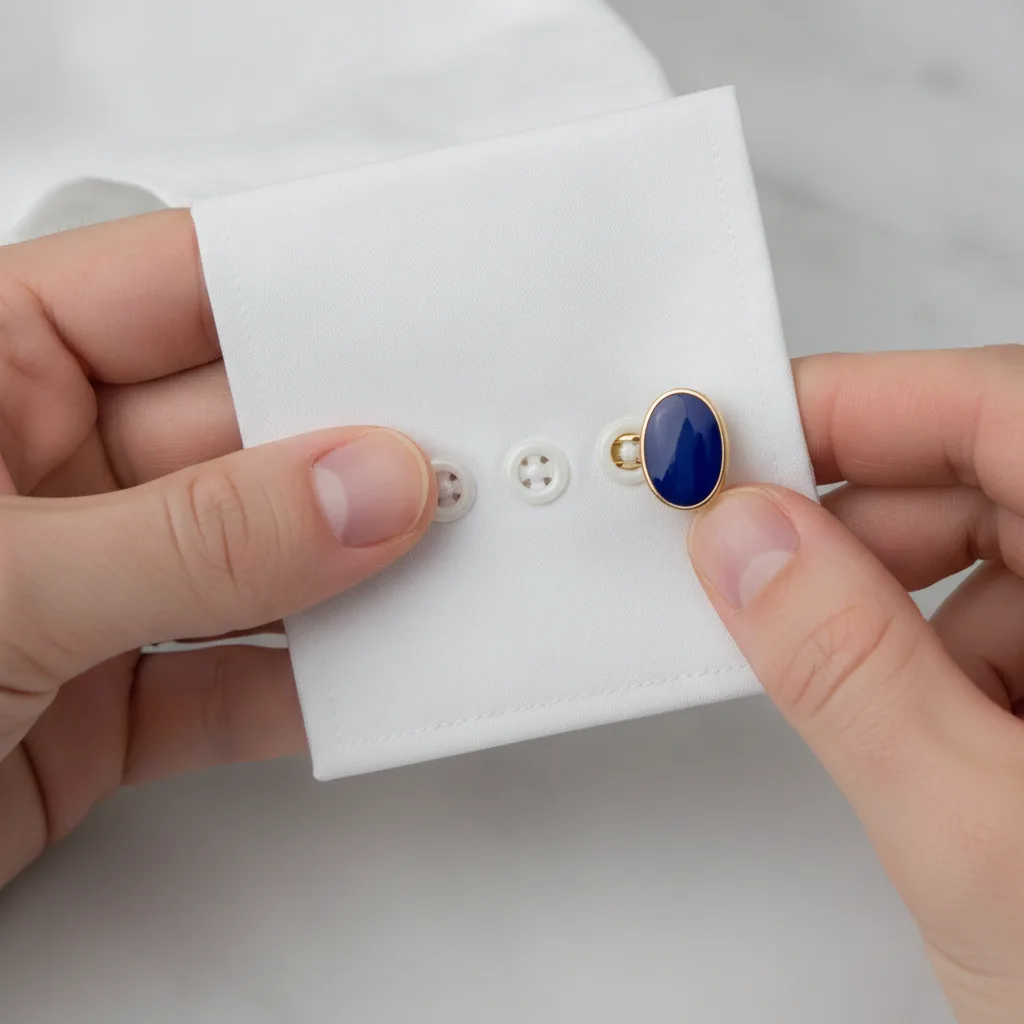
Putting them on is simple once you have the knack:
- Unfold the cuff completely.
- Fold the cuff back on itself to line up the four layers of fabric.
- Bring the buttonholes together.
- Slide the post through all of them.
- Turn the fastening horizontal to lock it.
The two faces should stay parallel: the cuff is not pinched together like an ordinary button cuff but closed edge to edge.
When it comes to combinations, a few pointers are enough. With a white shirt, blue or burgundy enamel cufflinks create a clear echo with the tie or pocket square. With a pale blue shirt, deep blue, forest green and above all black enamel cufflinks bring a restraint that works at the office as well as in the evening. With a navy suit, white or red enamel makes an elegant contrast, while a grey suit takes almost any colour as long as it stays consistent with your watch and belt. You can explore our designs by colour or by shape.
Choosing your pair: the criteria to check
A successful purchase comes down to a few practical checks, especially online, where you cannot touch the material. Here are the points we recommend checking every time on a product page:
- The quality of the enamel: no visible bubbles, even colour, clean outlines and no hairline cracks at the corners.
- The base metal: brass, stainless steel, silver or plated metal, with the stated weight and dimensions.
- The fastening: sturdy, easy to operate with one hand and securely attached to the base.
- The level of formality: an understated pair for work and formal occasions, a bold design to express your personal style.
- The terms of sale: lead times, delivery charges, returns policy and warranty, especially for a personalised piece.
For a bold look, novelty enamel cufflinks come in coats of arms, geometric patterns and references to sport or film. Our themed collections such as golf or Star Wars illustrate this approach: a well-fired area of colour shows off a design far better than a print.
Personalised enamel cufflinks, gifts and weddings
Enamel is the ideal material for personalisation, because it takes bold areas of colour bounded by well-defined metal outlines. A company logo, initials, a family crest or a date translate very well into soft enamel, where each cavity receives its own colour. For personalised enamel cufflinks, always ask for a mock-up before production, and specify the colour references, the type of metal, a glossy or matt finish and the production lead time.
For a wedding, the logic is slightly different. Wedding enamel cufflinks are chosen understated for the groom, often matching the colour of the tie or the floral theme, and more freely for the best men and witnesses. They also make a lasting gift that can be kept and handed down, which explains the popularity of presentation in gift sets. The most popular designs, for every occasion, are gathered among our best sellers.
How to clean enamel cufflinks
Simple steps to care for enamel
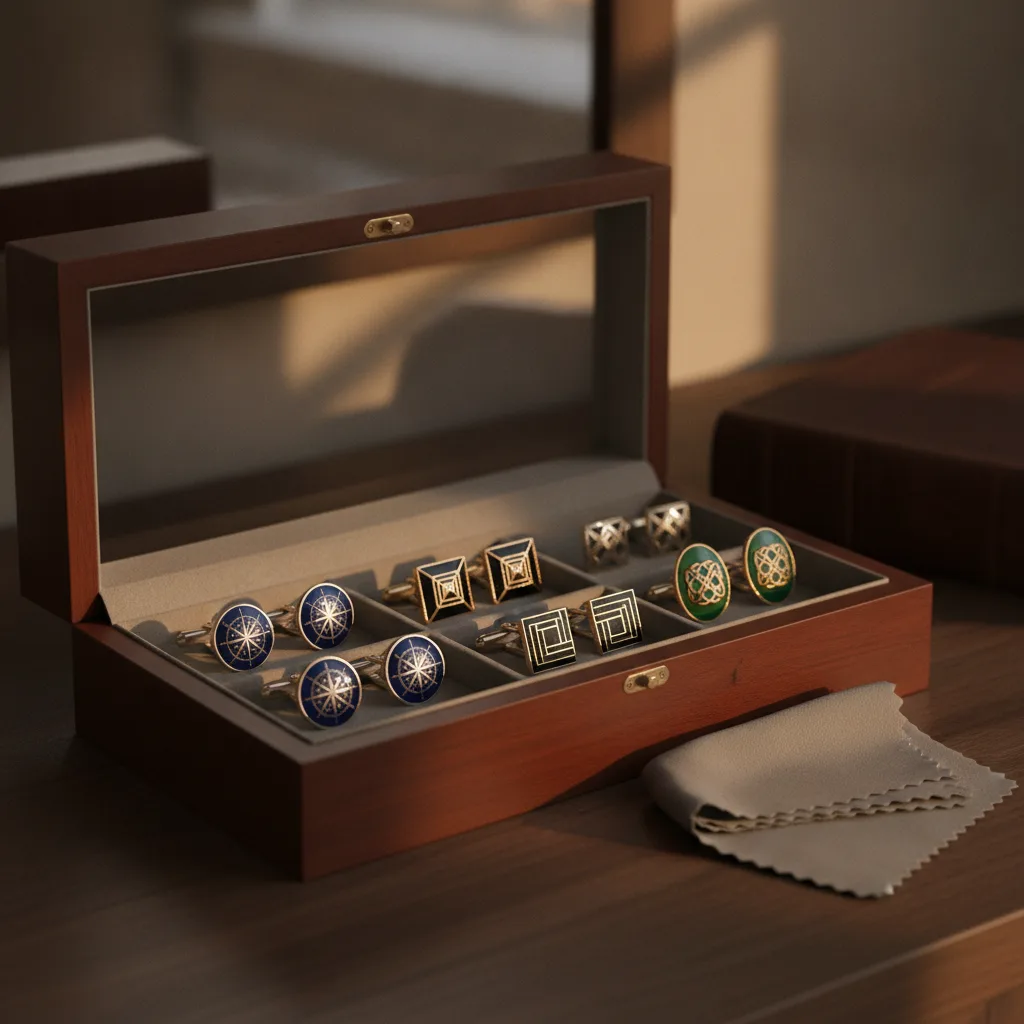
The rule is short: a soft, clean, dry cloth and nothing else in the vast majority of cases. The care recommendations published by specialist manufacturers agree that enamelled or plated pieces should be cleaned by wiping, never by abrasive rubbing. Remove the pair from the shirt, wipe each face, work gently around the fastening where perspiration builds up, then store the pieces separately.
Avoid immersing them unless the manufacturer says otherwise, as water can seep into the join between the enamel and the base. Also steer clear of solvents, abrasive powders, stiff brushes and chlorine. As for silver polishes, they are formulated to dissolve tarnish on silver and contain chemical or abrasive agents that can permanently cloud a vitreous coating or attack plating. If in doubt, the manufacturer's instructions always take precedence over general advice.
Important
If the enamel already has a tiny chip, avoid any wet cleaning. Water trapped under the coating speeds up lifting and makes a workshop restoration more difficult.
Enamel, a choice with character for your cuffs
Choosing enamel cufflinks means opting for a material worked with fire rather than mere surface decoration. The colour gains depth, the design gains sharpness, and the piece will last for years provided it is stored and wiped with a little method. Whether you are looking for men's enamel cufflinks for the office, a pair for a formal occasion or a pair to give as a gift, take the time to check the type of enamel, the base metal and the fastening. Do take a look at our new arrivals, as well as the pieces currently on clearance.
FAQ
Can you wear enamel cufflinks every day?
Yes, as long as you alternate pairs and take them off at the end of the day. Repeated daily wear of the same pair wears out the fastening faster than the enamel.
Can enamel change colour over time?
The colour, which comes from metal oxides fixed by firing, is stable. What changes is the metal base: unprotected brass or thin plating can tarnish on contact with perspiration.
What size of cufflink should you choose?
A small-diameter piece suits slim wrists and formal dress, while a larger design balances better with a substantial watch and thick twill or Oxford cuffs.
How should you travel with enamel cufflinks?
Put them in a rigid compartmentalised case in your cabin bag, and never loose in a pouch with keys or coins, which would cause fine scratches.
Can chipped enamel be repaired?
A specialist workshop can sometimes refill and re-fire the affected cell, but the operation remains tricky on a small surface. Check with the manufacturer before attempting any DIY repair.
Are enamel cufflinks suitable for women?
Absolutely. Worn with a shirt with French cuffs, they add a graphic touch and fit very well into a structured women's wardrobe.