

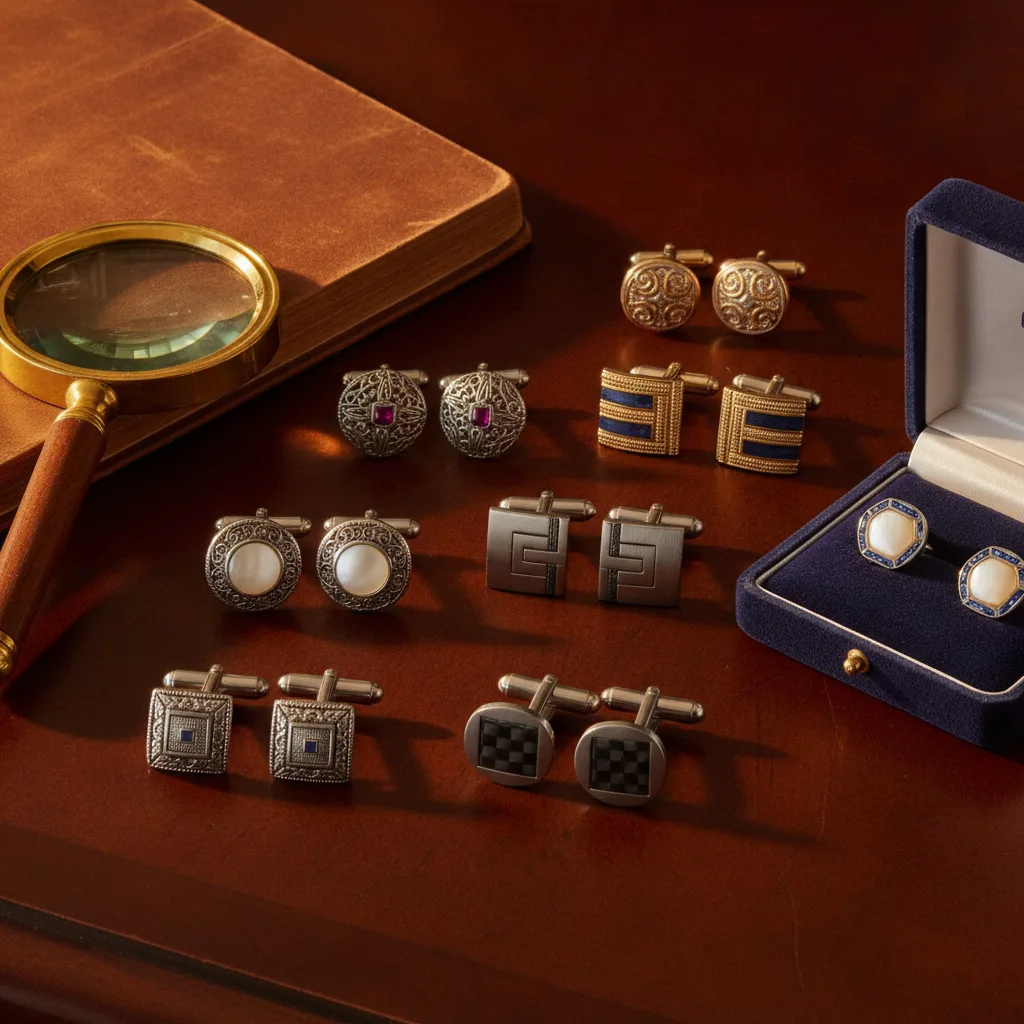
Collecting cufflinks is a quiet passion that appeals to more and more lovers of fine mechanisms and men's jewellery. Behind an antique pair lie a metal, a hallmark, a fastening mechanism and often a family story, but you need to know how to read these clues to avoid disappointing purchases.
This guide gives you a practical method to get started, identify, value, buy and look after your pieces. At Une Autre Paire de Manches, we regularly hear from collectors who began with a single pair and now own several dozen.
Collecting Cufflinks: The Complete Guide
Reading time: ~8 min
- Why collect cufflinks
- History and key periods to know
- Choosing a theme and setting a budget
- How to identify and date antique cufflinks
- Reading hallmarks and telling gold, plate and silver apart
- Valuing a pair without getting it wrong
- Where to buy vintage cufflinks in France
- Mistakes to avoid before buying
- Caring for and storing antique cufflinks
- Keeping a collection inventory
- Taking your cufflink collection further
- Frequently asked questions about collectable cufflinks
Why collect cufflinks
The cufflink holds a special place in a man's wardrobe. It is at once a functional object, a piece of vintage jewellery and a social marker. Unlike a watch or a ring, it can be collected without worrying about size, stored in a small space and actually worn.
A collector can therefore build a coherent set of collectable cufflinks on a budget that grows gradually. Many start with silver-tone metal or steel designs before moving on to solid gold or platinum.
A piece's appeal rarely rests on a single criterion. It comes from the combination of a material, rarity, a jewellery house, a period, a fastening mechanism and a documented provenance. It is this combination that turns an ordinary pair into a collector's item.
Vintage designs made between the 1930s and the 1970s are particularly prized for their craftsmanship and retro look, according to platforms specialising in antique jewellery.
History and key periods to know
The first cufflinks appeared as early as the 17th century. By the 18th century, pairs were already being made in gold, silver or mother-of-pearl, or decorated with miniature portraits and gemstones.
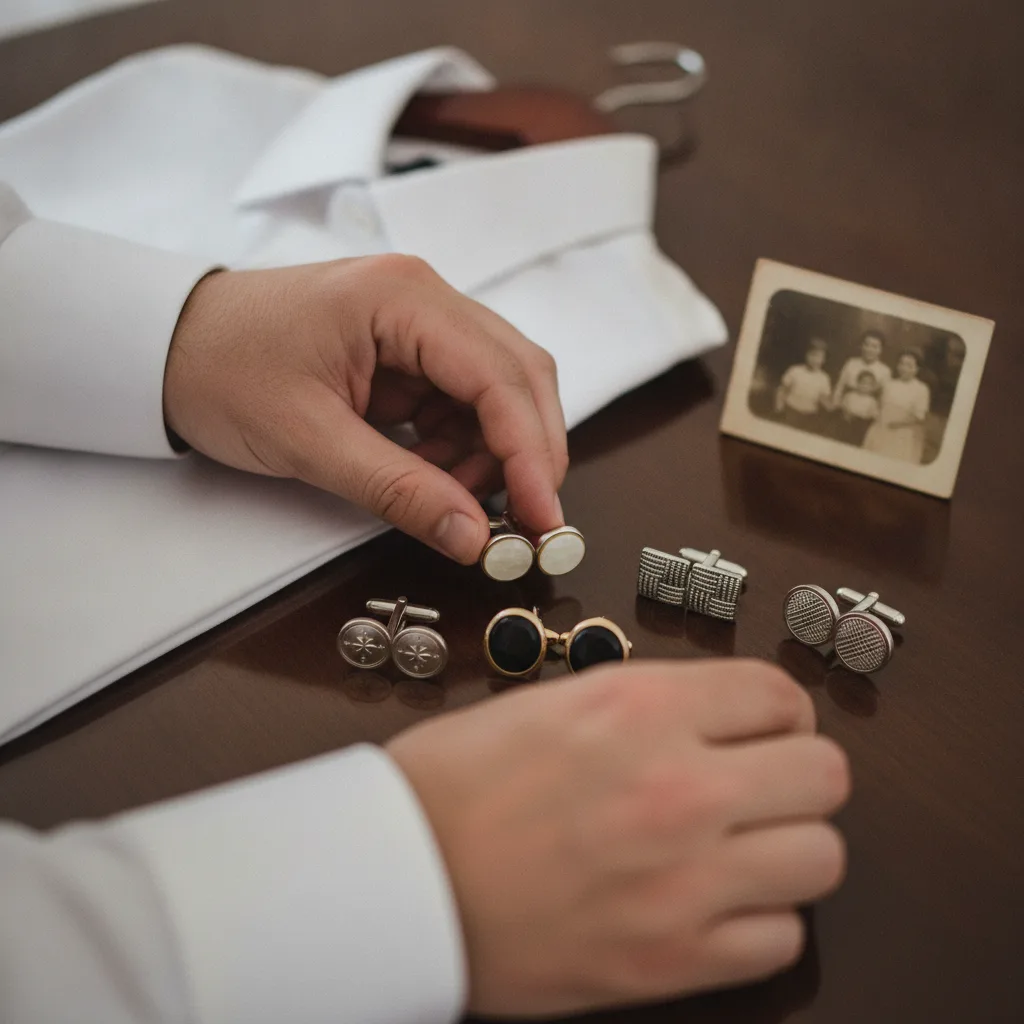
The history of the cufflink thus runs from the 17th century to its widespread adoption in the 19th century thanks to industrialisation, which explains the relative abundance of pieces from that period on the second-hand market.
The Belle Époque brought refined motifs and a strong influence from fine jewellery. The Art Deco period, between 1920 and 1940, is probably collectors' favourite hunting ground. Art Deco cufflinks are recognisable by their geometric lines, strong contrasts and use of onyx, enamel, mother-of-pearl, lapis lazuli and platinum.
Then come the decades from the 1930s to the 1970s, with great stylistic variety, followed by the contemporary era, dominated by luxury houses and specialist makers. For a living collection, it is worth complementing antique pieces with current designs, such as our Star Wars themed designs or our golf collection.
Choosing a theme and setting a budget
A collection without a common thread soon becomes a cluttered drawer. A theme gives structure to your searches, makes sorting easier and lets you compare prices in a meaningful way.
You might focus your collection on Art Deco, signed cufflinks, gold or silver designs, military or professional pieces, figurative and humorous cufflinks, or finishes set with onyx, mother-of-pearl and enamel. An aesthetic angle also works very well, by colour or by sorting by shape.
The budget, for its part, is never limited to the purchase price. You need to factor in any appraisal fees, restoring a tired mechanism, shipping and insurance, storage equipment and professional cleaning.
Our advice is simple: start with affordable pieces to learn how to recognise materials, fastening systems and flaws, then move upmarket once your eye is trained. Silk knot cufflinks, for example, are an excellent way in: affordable and very wearable.
Good to know
A complete, matching pair is almost always more sought after than a single cufflink. Before any purchase, check that both pieces share the same dimensions, decoration, colour and hallmarks, and are in comparable condition.
How to identify and date antique cufflinks
Dating is never done by eye on the basis of style alone. It comes from a body of combined clues: the design, the materials used, the hallmarks, the type of stones, the setting, the mechanism, signs of repair and any signature. A geometric pattern is no proof of age, since Art Deco motifs have been widely reproduced ever since.
The mechanism is a valuable clue. Examine the toggle, the hinge, the post, the chain, the swivel system, the condition of the spring and the symmetry between the two cufflinks. A loose fastening, a toggle that no longer holds or a replaced chain all affect the value of the piece.
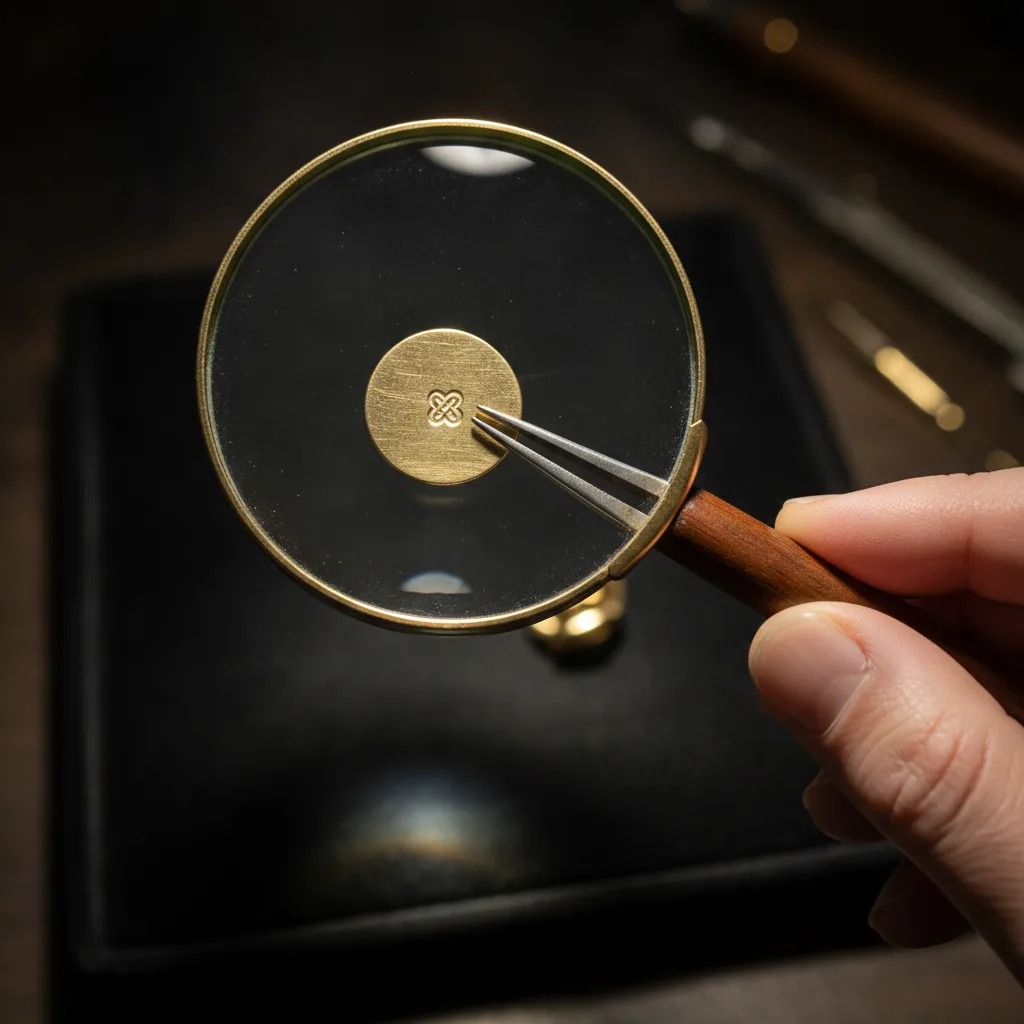
Always photograph the front and back, measure the dimensions, weigh the pair where relevant and examine the hallmarks under a loupe. A maker's signature, initials, a reference or a serial number add to a pair's appeal, but they must be consistent with the style, materials and quality of workmanship. A signature alone guarantees neither authenticity nor value.
Reading hallmarks and telling gold, plate and silver apart
The hallmark is the collector's number one tool. On a piece of French gold, the eagle's head hallmark guarantees the fineness of the metal. Remember to examine both cufflinks in the pair, as each may bear its own marks. Knowing how to recognise gold cufflinks avoids most buying mistakes, especially with listings that use vague phrases such as "old gold" or "probably gold".
| Material | How to identify it | What to watch for |
|---|---|---|
| Solid gold | Fineness hallmark, for example the eagle's head in France | Check that the stated weight matches the size of the piece |
| Gold plate | Thin layer of gold applied over another metal, marked "plaqué" or "doublé" (rolled gold) | Wear to the layer on the edges and around the mechanism |
| Solid silver | Silver hallmark matching the fineness | Natural tarnishing, not to be mistaken for a flaw |
| Gold-tone or silver-tone metal | No precious metal hallmark | Often sold as vintage with no detail about the material |
| Imitation | Precious appearance without consistent marks | Have any expensive piece checked by a professional |
The term "plated" refers to a thin layer of gold or silver applied over a base metal. Well-made antique plate can have genuine aesthetic and historical interest, but its intrinsic value bears no comparison with that of solid gold. For an important piece, a test carried out by a jeweller is always preferable to a simple visual check.
Valuing a pair without getting it wrong
The valuation criteria to consider
The value of a pair depends on the house or signature, the period, rarity, the metal and its weight, the stones and the quality of the setting, the condition of the mechanism, provenance, whether the original box and paperwork are present, and real market demand. A serious valuation takes all of these factors into account, not just one of them.
The most useful rule fits in one sentence: an asking price is not proof of value. Always compare with pieces that have actually sold, particularly at public auctions.
For a formal appraisal, you can turn to an antique jewellery expert, a member of the Chambre Nationale des Experts Spécialisés or the Compagnie Nationale des Experts (the French professional bodies of appraisers), or the auction houses operating at the Hôtel Drouot in Paris. Having cufflinks valued before a significant purchase always costs less than a mistake.
Where to buy vintage cufflinks in France
Jewellers and specialist houses offer the best traceability, with detailed descriptions and sometimes a guarantee. Auctions let you unearth rare pieces, provided you factor in the buyer's premium, taxes, shipping and possible restoration.
Antique dealers and vintage shops hold some lovely surprises, but condition and authenticity need careful scrutiny there. Platforms devoted to antique jewellery sort their pieces by metal, period or style, which makes themed searching easier.
Finally, general marketplaces and private sales offer attractive prices, with a much higher risk of inaccurate descriptions, mismatched pairs or counterfeits.
A balanced collection often mixes antique pieces with contemporary designs that can be worn every day. That is why we suggest keeping a regular eye on our new arrivals and our most popular designs.
Mistakes to avoid before buying
Most disappointments come from buying too quickly on the strength of a single blurry photograph. Here are the habits to adopt every time before confirming an order.
- Ask for sharp images of the hallmarks and the back of both cufflinks.
- Check whether the price is for a complete pair or a single cufflink.
- Ask for the weight, the dimensions and the exact type of metal.
- Check that the fastening works properly and that there is no crude repair.
- Be wary of vague wording such as "in the style of a great house".
- Insist on an invoice stating the material and check the returns policy.
Important
Never attempt aggressive cleaning before an appraisal. Clumsy polishing can wipe out a shallow hallmark and send the value of an antique piece tumbling.
Caring for and storing antique cufflinks
Simple steps to look after your cufflinks
Everyday care could not be simpler. After each wear, wipe your cufflinks with a soft, dry cloth, then store them separately in a pouch or compartmentalised box to prevent scratches and metals rubbing against each other.
Protect them from water, damp, perfume, household products, abrasives, knocks and large swings in temperature. Delicate materials such as mother-of-pearl, stone, wood and plated finishes call for extra care.
Polishing should remain the exception on an antique, engraved or chased piece, because overdoing it wears away the detail and reduces the historical interest of the jewel. Solid silver, for its part, may need protection against tarnishing.
For storage, choose a dry place away from strong light, with dividers by type of metal, inventory labels and, for valuable pieces, a safe. A handsome display box is also part of the pleasure of collecting, and our presentation gift sets fill that role perfectly.
Keeping a collection inventory
An inventory is what separates a collection from mere accumulation. Each pair deserves a detailed record, useful for insurance, resale and passing on. Record at least the following information.

Information to record in your inventory
- Inventory number, date of purchase, seller and price paid.
- Front and back photographs, dimensions and weight.
- Materials, hallmarks noted, signature and presumed period.
- Condition of the mechanism, any restoration and storage location.
- Invoice, certificate and any valuation.
Taking your cufflink collection further
Collecting cufflinks takes little space, a patient eye and a consistent method. Choose a theme, learn to read hallmarks, always check the mechanism and that the pair matches, document every purchase and keep your pieces safe.
Done this way, your collection will grow more coherent year after year, and each new acquisition will complete a well-thought-out whole rather than a pile of one-off purchases. To add to your collection at a sensible price, it is also worth browsing our current offers.
In short: collecting cufflinks
With a clear theme, a sound reading of hallmarks, a realistic view of prices and a few simple care habits, you lay solid foundations for collecting cufflinks over the long term. The key is to build your collection methodically, putting coherence first along with the pleasure of wearing or admiring each pair.
FAQ
Should you wear collectable cufflinks or keep them untouched?
Both approaches are defensible. Contemporary pieces and sturdy plated pairs can be worn without worry, whereas antique designs with a fragile mechanism or set stones are best kept for special occasions, or even displayed in a cabinet.
What kind of shirt do you need to wear cufflinks?
You need a shirt with French cuffs, also known as double cuffs, whose two edges meet flush. Ordinary buttoned cuffs cannot take them, except for hybrid designs made for the purpose.
Should a cufflink collection be insured?
Once the total value becomes significant, it makes sense to add a valuables extension to your home insurance policy. Your photographic inventory and your invoices then serve as the supporting evidence required in the event of a claim.
How should you carry cufflinks when travelling?
Use a rigid compartmentalised case kept in your hand luggage. Avoid soft pouches in which the pieces knock together, as edges and plated finishes get damaged very quickly by rubbing.
Is a mismatched pair of any interest to a collector?
Its market value is limited, but a single cufflink remains useful as a study reference, for comparing a hallmark, a mechanism or a decoration with a future acquisition.