


A business trip, a wedding abroad or a trade fair at the other end of Europe, and the same question comes back for any man used to wearing a suit: how do you travel with cufflinks without losing one on the way or finding a scratched pair at the bottom of your suitcase? These small suit accessories often carry sentimental or monetary value far greater than their size.
At Une Autre Paire de Manches, we regularly get this question from customers who travel with their double-cuff shirts. Here is a complete method, from packing to airport security, through to care once you are home.
Travelling with Cufflinks: A Practical Guide
Reading time: ~8 min
- Can you take cufflinks on a plane?
- How to pack cufflinks without damaging them
- Which case or pouch to choose for carrying cufflinks
- Which cufflinks to choose for a business trip or a wedding
- How to clean cufflinks after a trip
- The checklist: before you leave, on the way and on arrival
- Buying a pair before a trip: how much time to allow
- Travelling light with your cufflinks: the key points
- Frequently asked questions
Can you take cufflinks on a plane?
In the vast majority of cases, travelling with cufflinks poses no particular difficulty. These accessories are accepted in hand luggage as well as in the hold. Their small size and metal construction simply call for a common-sense precaution: keep them together in an easily accessible pouch or case rather than letting them roam freely in a bag.
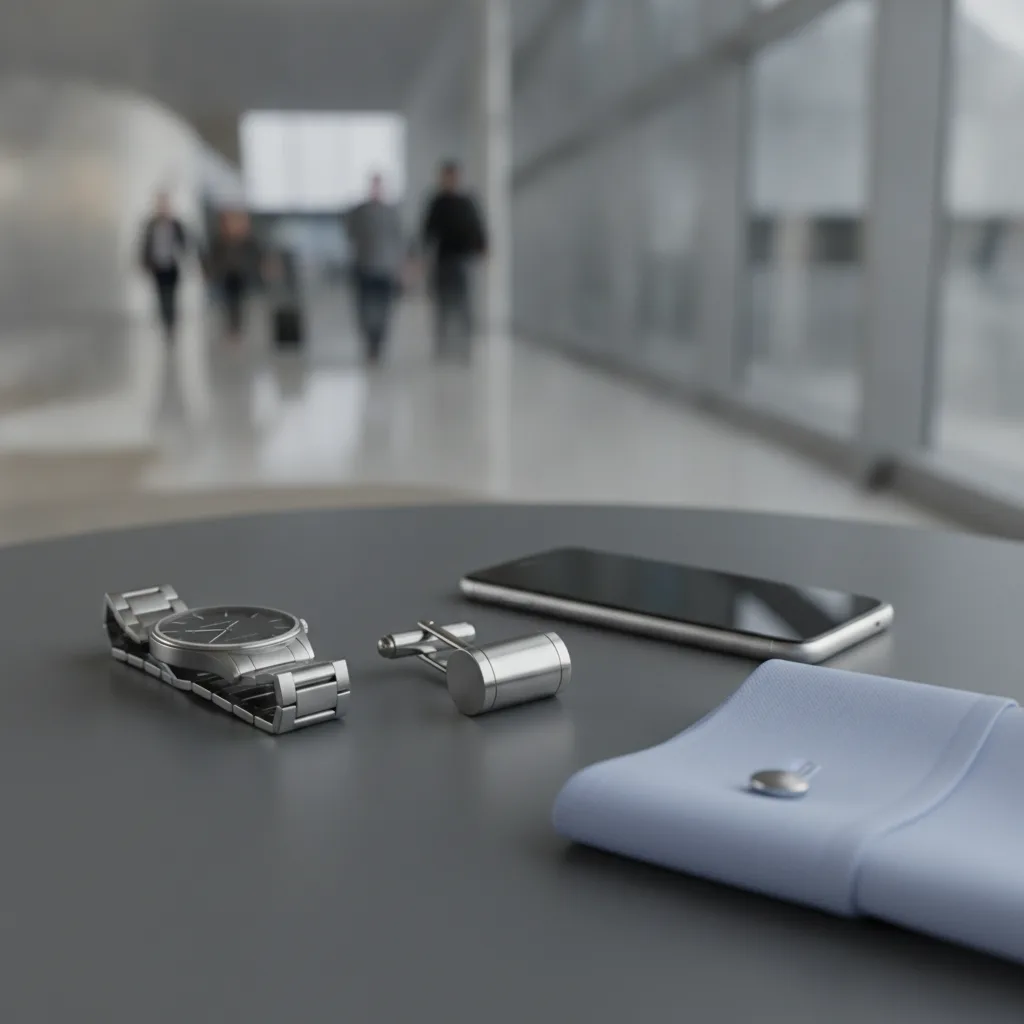
Metal objects such as keys, coins and cufflinks are best taken out of your pockets before going through the scanner, to avoid a second pass through security and, above all, to avoid leaving them behind in a tray.
Security rules are set by the relevant authorities, such as the TSA in the United States or the DGAC (French civil aviation authority) in France, and may vary by airport and destination. We therefore recommend checking the rules of your departure airport before a sensitive journey. In practice, taking cufflinks on a plane comes down to one simple rule: never put the cufflinks straight into the security tray, but place the closed case containing them there instead.
Hand luggage or hold?
The hold is not forbidden, but it exposes luggage to knocks, crushing and changes in humidity. For designs in 925 silver or 18-carat gold, set with stones or steeped in family history, hand luggage remains the most sensible choice. For an everyday pair in stainless steel or with a gold-plated finish, the hold is an option, provided you use a rigid case placed in the middle of the suitcase, away from heavy objects.
How to pack cufflinks without damaging them
The main cause of damage when travelling is neither loss nor water, but scratches from friction. Two pairs touching each other for an eight-hour journey are enough to mark a polished surface. The rule is therefore to store each pair individually, in a separate, padded compartment, ideally lined with velvet or felt.
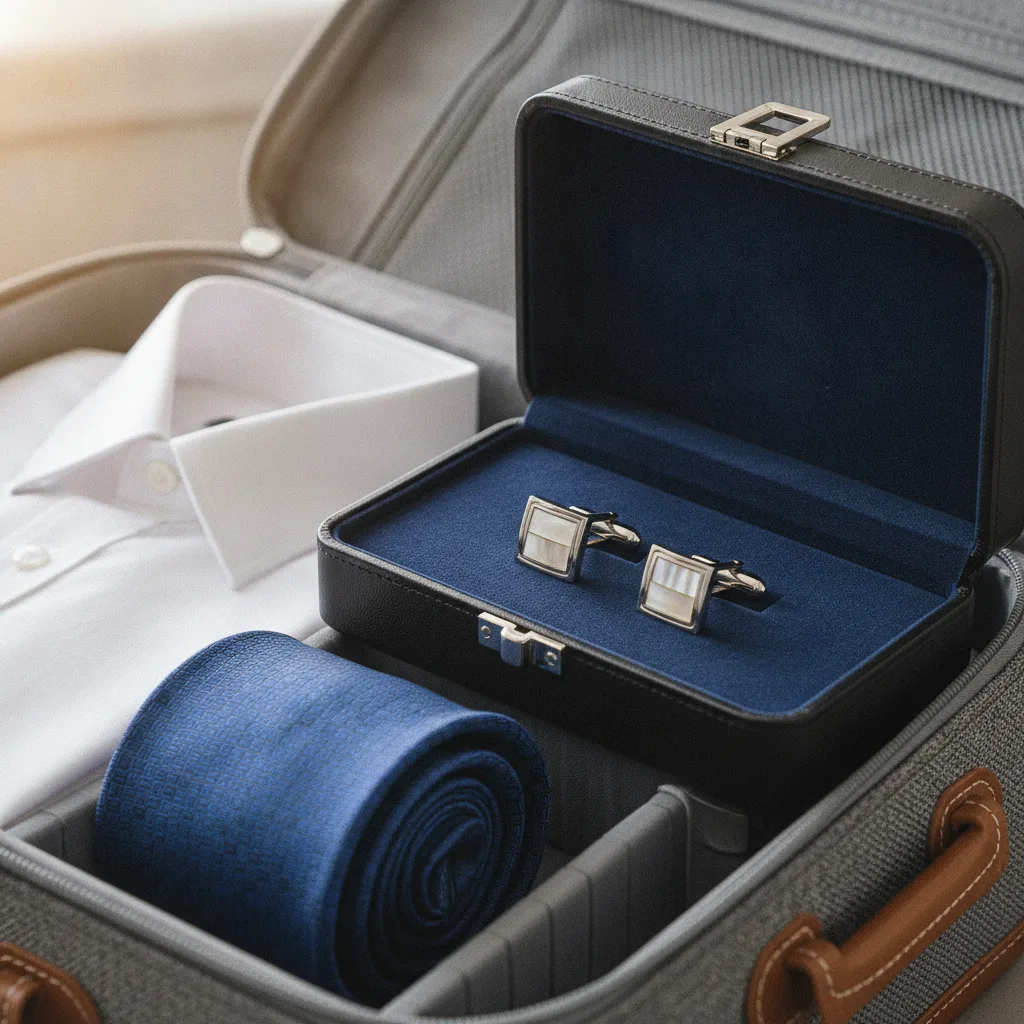
Here is the method we recommend for packing cufflinks in a suitcase or cabin bag:
- Close each pair on itself by locking the swivel mechanism, so that the post does not move around freely.
- Put each pair in its own slot in a compartmented box, or in a small fabric pouch if you do not have a padded case.
- Keep the cufflinks away from other metal objects such as watches, tie pins or belt buckles.
- Place the case at the heart of your luggage, surrounded by clothing, never in an outside pocket or in your wash bag, where damp and cosmetics circulate.
- Check that both pieces are there before you leave and as soon as you arrive; this habit avoids most unpleasant surprises.
Good to know
Perfumes, lotions and harsh chemicals damage some finishes and speed up the tarnishing of silver. Always keep your cufflinks well away from your wash bag.
Which case or pouch to choose for carrying cufflinks
Not all containers are equal, and the right choice depends on the length of the trip, the value of the pieces and the space available. A soft pouch slipped into an inside jacket pocket is enough for a twenty-four-hour return trip. A rigid case is a must as soon as the pair travels in the hold. An anti-tarnish pouch meets a specific need: slowing the tarnishing of silver during a long stay or in a humid climate.
| Storage option | Protection against knocks | Protection against scratches | Recommended use |
|---|---|---|---|
| Soft fabric pouch | Low | Good if only one pair | Short trip, hand luggage |
| Original padded box | Medium to good | Very good | One pair, business trip |
| Compartmented box lined with velvet or felt | Good | Excellent | Several pairs, long stay |
| Rigid travel case | Excellent | Very good | Hold luggage, valuable pieces |
| Anti-tarnish pouch | Low | Good | 925 silver, humid climate |
Our orders ship in a gift box, which settles the question of transport with no extra purchase. These boxes make a reliable storage base, including for a trip lasting several days.
Which cufflinks to choose for a business trip or a wedding
Travelling means striking a balance between elegance and toughness. For frequent business travel, stainless steel remains the most forgiving material: it does not tarnish like silver, cleans with a simple wipe of a cloth and copes with being handled quickly in an airport concourse. A versatile design, simple in shape and neutral in colour, goes with several shirts and saves you packing three pairs for three days. Our selections by shape and by colour help you find a single pair that works with a whole wardrobe.
For cufflinks intended for a wedding abroad, the logic changes. The accessory becomes visible, photographed, commented on. A pair of silk knots, supple and with no rigid mechanism, travels with no risk of scratching and adds a controlled touch of colour. If the dress code is more formal, a classic pair with a swivel fastening remains the safe choice, provided you try it beforehand on the shirt you plan to wear, with its French cuffs.
One last, often overlooked point is skin tolerance. The EN 1811 standard governs nickel release from jewellery and accessories in contact with the skin. For a long-haul flight followed by a full day in a suit, it is better to wear a pair whose behaviour over several hours you already know.
How to clean cufflinks after a trip
Once home, ten minutes of care is enough to keep your pieces in good condition for the long term. Start by wiping them dry with a non-abrasive cloth to remove the dust and traces of perspiration built up while wearing them. For a deeper clean of metal designs without set stones, lukewarm water with a mild detergent, a soft toothbrush and a cotton cloth for drying give good results. Drying must be thorough and immediate, as moisture is the leading cause of damage to metals.
Silver needs extra vigilance. It naturally darkens on contact with air and perspiration. A polishing cloth designed for precious metals restores its shine, and storing it in an anti-tarnish pouch limits the effect between wears. Gold does not tarnish but scratches easily, hence the value of storing each pair separately. Steel needs nothing more than a slightly damp cloth followed by drying. As for designs set with stones or decorative elements, they should be kept away from prolonged contact with water and from any abrasive product. Bleach and harsh cleaners should be avoided on every finish, including costume jewellery.
Important
Always check the mechanism before setting off again. A toggle that turns too freely or a slightly loose post is a sign you will lose a cufflink in the middle of a working day.
The checklist: before you leave, on the way and on arrival
A pre-departure checklist prevents last-minute oversights, especially when an important meeting awaits you on arrival. Here are the points to check every time:
- Before you leave: choose the pair suited to the shirt and the occasion, test the mechanism on the French cuff in question, wipe the cufflinks with a soft cloth, put them in their box and pack the box in your hand luggage.
- On the way: keep the case in a closed compartment, never put the cufflinks loose in a trouser or jacket pocket, and hand over the whole pouch at security if an inspection is requested.
- On arrival: check that the pair is complete, look for any scratches or signs of moisture, then wipe and store them somewhere dry until you need them.
Buying a pair before a trip: how much time to allow
An order placed the day before a flight is a gamble. Lead times observed among suit accessory sellers range from forty-eight hours to several working days depending on the product, the delivery method and the time of year. On top of that come withdrawal periods, generally between fourteen and thirty days depending on the retailer, which are only useful if you receive the pair early enough to try it. These conditions change and should be checked at the time of purchase.
Our advice is simple: allow at least a week before a business trip, and two to three weeks before a ceremony, so that you can try the pair with the shirt, check that the mechanism holds and, if needed, look into the seller's returns conditions. For a quick, no-hesitation purchase, our best sellers bring together the most popular designs in our catalogue. Fans of themed designs will also find pieces dedicated to the world of Star Wars or to golf, and our new arrivals are refreshed regularly.
Travelling light with your cufflinks: the key points
Travelling with your cufflinks calls for neither expensive equipment nor a complicated routine. A padded box, individual storage for each pair, hand luggage for valuable pieces and a systematic wipe once you are home are enough to keep your accessories in good shape for years.
The real risk is not the plane, it is improvisation: a pair left loose in a suitcase pocket or put down on a hotel table. Adopt the checklist, keep the case closed until you arrive, and your cufflinks will cross as many time zones as you do.
FAQ
Do valuable cufflinks need to be declared at customs?
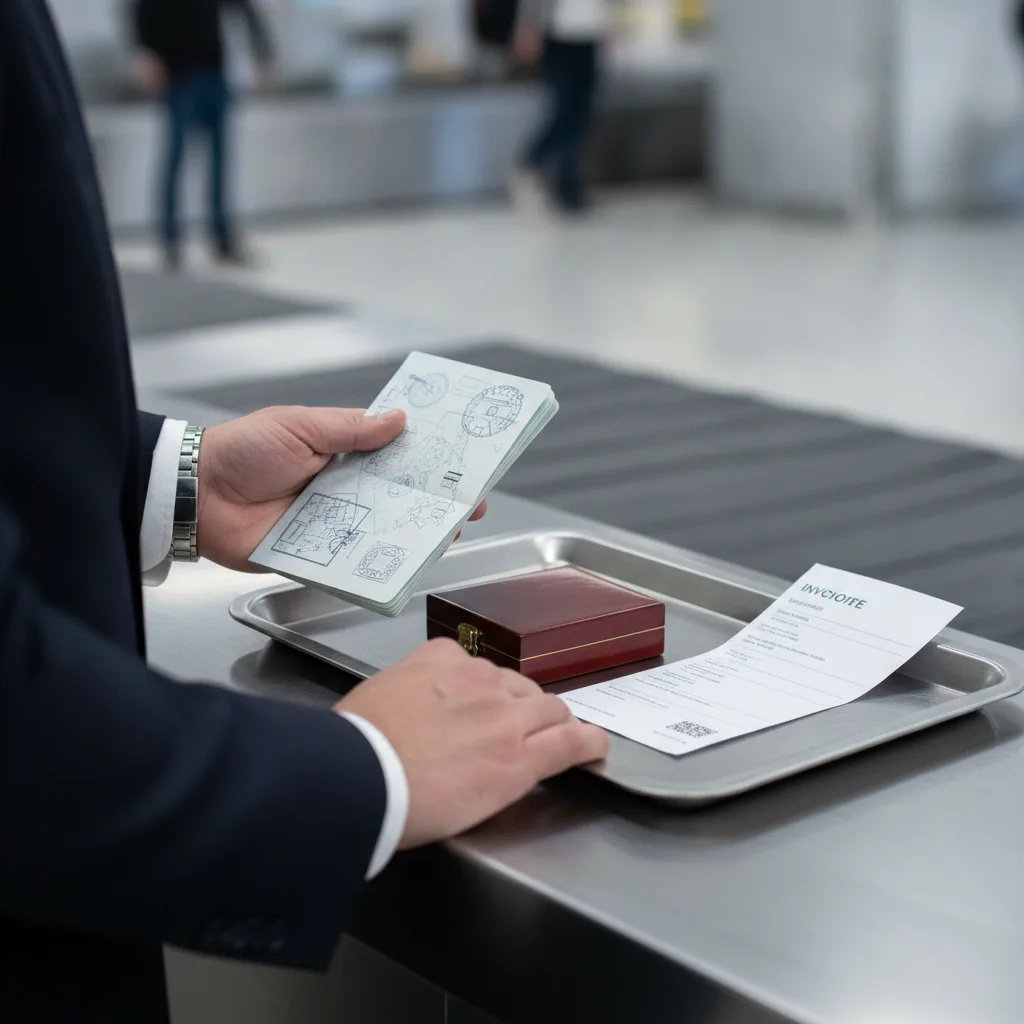
For personal use when travelling within the European Union, no formalities are required for accessories worn or carried. For a high-value piece taken outside the EU, keeping the purchase invoice makes it easier to prove prior ownership on your return. If in doubt, check with the customs authority of the country concerned.
Will a metal detector react to cufflinks you are wearing?
That depends on the amount of metal and how the scanner is set. A pair in steel or solid metal may set off an alert. The simplest solution is to take them off before security and put them back in their case, which also stops you losing them in a tray.
Can you carry cufflinks in a rucksack without a case?
This is the riskiest scenario. Without protection, cufflinks scatter, get scratched by keys or pens, and a piece can come loose. A simple fabric pouch, however basic, makes a radical difference to the level of protection.
How can you avoid losing a cufflink during the day?
Check the fastening after every trip to the cloakroom or after taking off your jacket, because those are the moments when toggles work loose. If the mechanism has any play, switch to another pair rather than take the risk.
What should you do if a pair has tarnished during your stay?
A polishing cloth suited to the metal in question is usually enough. Never use an abrasive product or toothpaste on a gold-plated finish, as you risk removing the plating.
Are there designs suited to frequent travel?
Yes, stainless steel designs with a simple mechanism and silk knot cufflinks are the most tolerant of being transported. You will find reduced-price options on our sale page for putting together a dedicated travel pair.