


A shirt cuff gets noticed far more than you might think. It appears with every handshake, every gesture across a table, every ceremony photograph. Silk cufflinks, usually called silk knots, are one of the rare accessories able to add colour without ever tipping into ostentation.
You still need to be able to tell genuine natural silk braiding from a polyester plait sold at the same price. This guide gives you concrete pointers for choosing, wearing and caring for this accessory.
Silk Knot Cufflinks: The Complete Guide
Reading time: ~11 min
- What are silk knot cufflinks?
- Silk or polyester knots: why the material changes everything
- Silk or metal cufflinks: how to decide
- How to match silk knot cufflinks to your outfit
- How to fit cufflinks to a shirt with French cuffs
- Caring for and storing silk knot cufflinks
- What to budget and what to check before ordering
- Which designs to choose for each occasion
- Going further with silk knot cufflinks
- Frequently asked questions about silk knot cufflinks
What are silk knot cufflinks?
A silk cufflink consists of two braided knots joined by a cord or an elastic link. There is no swivel mechanism and no metal clasp, just a supple braid that passes through the buttonholes of the cuff. This form, known as the silk knot, belongs to the vocabulary of passementerie, the textile craft that has produced braids, cords and knotted trimmings for clothing and furnishings for centuries.
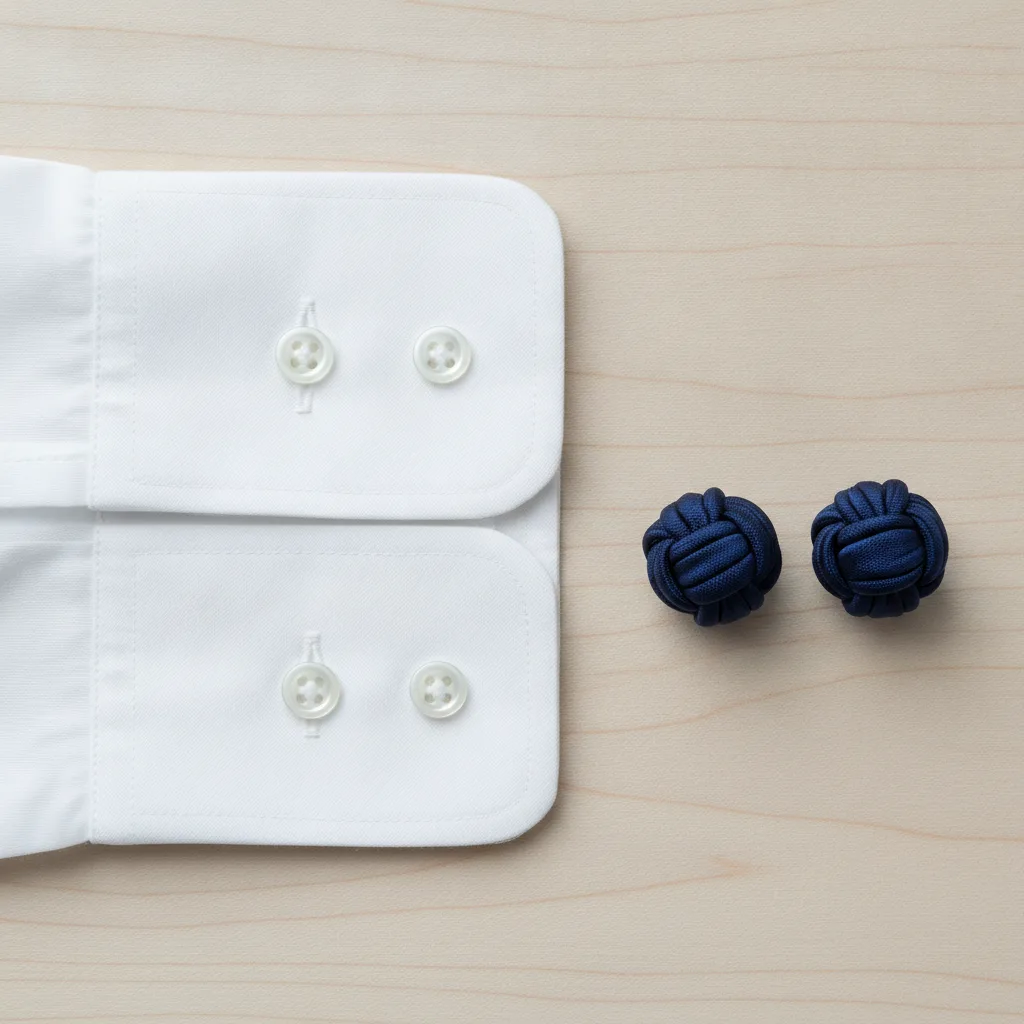
These accessories are worn exclusively with a shirt with French cuffs, also known as double cuffs. This type of cuff, standard in formal menswear, folds back on itself and has four aligned buttonholes, with no sewn-on button. A shirt with single button cuffs will not take them. This is the first thing to check before buying, as a great many disappointments start right there.
The flexibility of the elastic link accounts for much of their comfort. Where a rigid design holds the cuff in a fixed position, a silk knot follows the movement of the arm, which makes it particularly pleasant over a full day at the office or a long reception.
Silk or polyester knots: why the material changes everything
This is where the biggest quality gap on the market lies. Visually, a polyester knot and a natural silk knot look alike in a catalogue photo. In the hand, the difference is immediate. Natural silk has a deep, shifting lustre that catches the light differently depending on the angle, whereas synthetic fibre gives off a uniform, rather flat sheen. To the touch, silk is supple, dense and slightly cool, while polyester remains stiff and slippery.
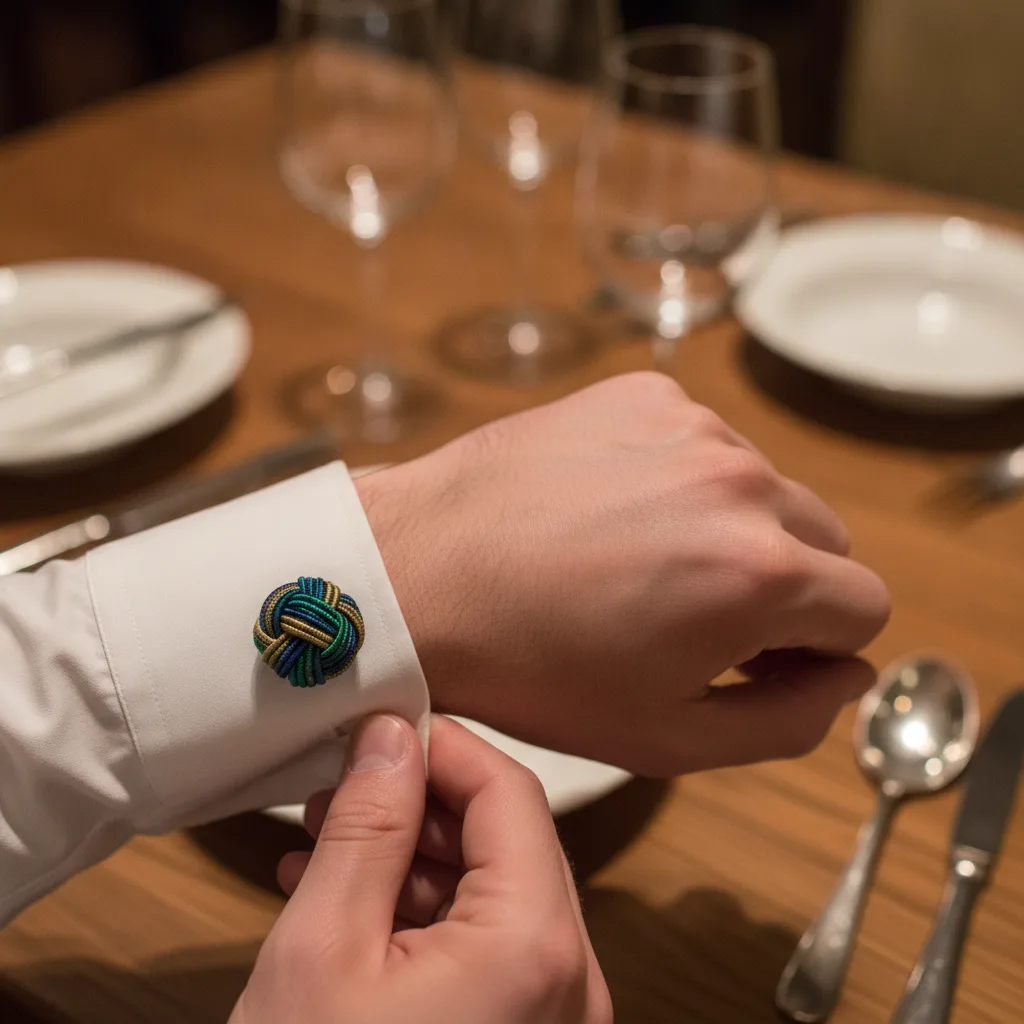
Durability follows the same logic. A well-made silk braid keeps its roundness and crisp edges after dozens of wears, whereas a synthetic plait tends to flatten, pill at the friction points and lose its original colour. Dyeing is another tell-tale sign. Natural textile fibres absorb pigments deeply, giving dense navy blues, warm burgundies and deep greens that cannot be achieved with the same accuracy on synthetics.
At Une Autre Paire de Manches, we select our silk knots by looking at the regularity of the braiding, the symmetry of the two knots and the strength of the central link. You will find all these designs in our silk knots collection, also arranged by shade in our selection by colour.
Good to know
On a product page, the exact statement of composition is the only reliable clue. Vague wording such as "silk look" or "silky feel" almost always means a synthetic textile.
Silk or metal cufflinks: how to decide
The question comes up every time. It does not call for a single answer but for a trade-off between level of formality, budget and use. The table below sums up the most useful points of comparison.
| Criterion | Braided silk | Metal |
|---|---|---|
| Style | Colourful, supple, smart-casual elegance | Structured, classic, very formal |
| Observed price | Around €20 at entry level, up to roughly €50 for more elaborate designs | Highly variable, from entry level to luxury |
| Durability | Good in normal use, textile more fragile than steel | Generally sturdier |
| Comfort | Light, elastic link that follows the wrist | More rigid, depending on the fastening |
| Care | Delicate, sensitive to water and stains | Often simpler |
| Occasions | Office, wedding, cocktail party, evenings out | Dinner suit, ceremonial dress, strict dress code |
| Coordination | Silk tie, pocket square, bow tie, braces | Watch, tie clip, suit buttons |
In practice, silk wins whenever you are after a touch of colour and a less rigid silhouette. Metal remains preferable for a dinner suit or a highly codified black-tie outfit. Many men own both and alternate according to how formal the day is.
How to match silk knot cufflinks to your outfit
The most effective rule is to create an echo, never a repetition. A perfect match between tie, pocket square and cufflinks produces a stiff, boxed-set effect. A similar shade or a controlled contrast gives a far more accomplished result.
With a white shirt, almost any colour works. Navy, burgundy and black are the most versatile choices. With a pale blue shirt, go for a dark blue, a grey, a deep red or a purple. On a pink or lavender shirt, opt for a darker shade to avoid a uniform look. On a dark suit, coloured silk becomes the only bright spot in the outfit, which is exactly what it is there for.
Navy silk knot cufflinks are the safest first purchase. They go with a grey suit, a blue suit and a double-breasted jacket, and work as well in a meeting as at a dinner. To widen your rotation afterwards, our best sellers give a good overview of the most-worn colours, while our new arrivals let you explore bolder shades.
How to fit cufflinks to a shirt with French cuffs
The technique takes a minute to learn and soon becomes second nature.
Steps for putting on silk knot cufflinks
- Unfold the shirt cuff completely.
- Fold the cuff back on itself, inside to inside, so that the layers of fabric sit on top of each other.
- Line up the four buttonholes.
- Insert the first knot through the first two layers, then pass the second knot through the whole cuff by pulling on the link, never directly on the knot itself.
- Check that the braid sits properly on top of the cuff, visible below the jacket sleeve, and repeat on the other arm.
Two mistakes damage a silk design prematurely. The first is forcing it through a buttonhole that is too narrow, which stretches the braiding. The second is pulling on the knot rather than the link, which eventually loosens the braid. On a new shirt, a buttonhole that is a little stiff at first will ease after a few wears.
Caring for and storing silk knot cufflinks
Silk does not tolerate prolonged soaking. Water, perfume and cosmetics damage the fibres and dull the colours. So always remove your cufflinks before washing or ironing the shirt, and put them somewhere safe from splashes. If they get stained, do not rub: dab gently and leave to air-dry. For a stubborn stain, professional dry cleaning remains the safest solution. The soapy water and soft brush method, suitable for metal parts without set stones, must never be used on silk knots.
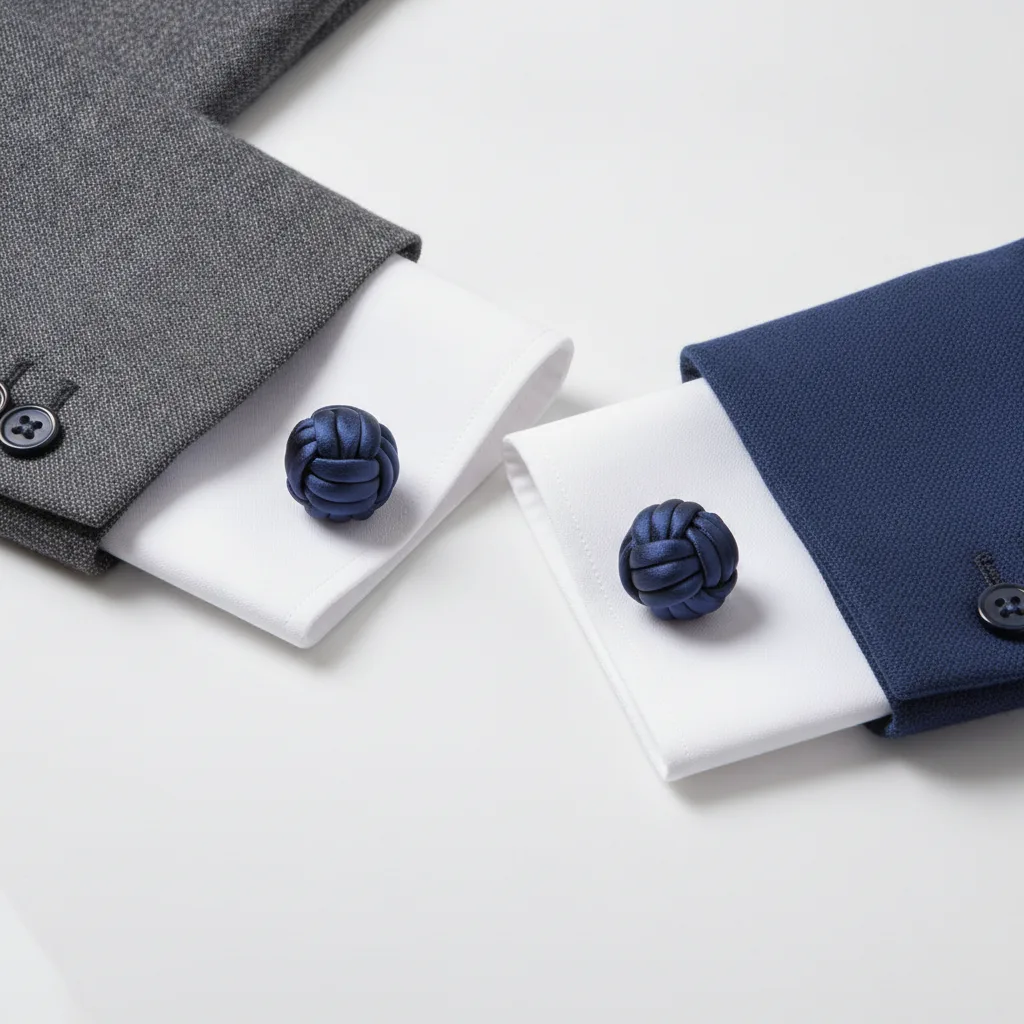
Storage matters as much as cleaning. A compartmented box or a velvet-lined tray prevents pairs from rubbing against each other and preserves the roundness of the knots. Check the condition of the elastic link regularly, as it is the part of this type of accessory that wears out. Our gift sets serve for both presentation and storage, which makes them a practical basis for building a collection.
Key takeaway
A silk knot that is stored properly and kept away from damp will hold its sheen for years, whereas one left at the bottom of a jacket pocket loses its shape within a few weeks.
What to budget and what to check before ordering
Prices observed on the market put entry-level pairs at around €20, with more elaborate designs approaching €50, depending on the quality of the silk, the finish and the packaging. As a benchmark, several silk references are listed at €19.95 by the retailer Suitable, in cobalt, turquoise or purple. These figures are rough guides noted at the time of writing and vary from one retailer to another. Established houses such as Brooks Brothers, which sells silk knots with standard delivery stated at three to seven working days, or Harvie and Hudson, with its black elastic silk knot, confirm the lasting place of this form in the men's wardrobe.
Before confirming an order, a few checks will save you unpleasant surprises.
Points to check on the product page
- The exact composition: natural silk or a textile blend
- The presence and quality of the elastic link
- The size of the knots and the symmetry of the two ends
- The regularity of the braiding and the absence of pulled threads in the close-up photos
- The dispatch time, the delivery cost and whether gift wrapping is available
- The seller's own returns policy
On that last point, a distance purchase from a business established in France gives you a right of withdrawal governed by the French Consumer Code, with possible exceptions for personalised items. Commercial policies vary widely from one site to another, with some retailers offering fourteen days and others thirty or sixty. Always read the terms of the shop concerned. On a tighter budget, our sale section lets you try out colours without a significant financial commitment.
Which designs to choose for each occasion
At the office, stick to understated shades such as navy, charcoal grey, black or burgundy. The accessory is noticed up close, which is exactly the effect you want in a professional setting. For a wedding, silk is particularly well suited, whether you are the groom, a best man or a guest. Coordinate the shade with your tie or with the theme of the ceremony, keeping a difference in tone from your pocket square. For a cocktail party or an evening out, bright colours and two-tone combinations come into their own. For a very formal ceremonial outfit with a dinner suit, however, go back to an understated metal design.
Finally, silk knot cufflinks make an easy gift, because they do not depend on size or build. A versatile colour, careful presentation, and the job is done.
Going further with silk knot cufflinks
Choosing silk knot cufflinks comes down to balancing three things: the real quality of the braiding, the colour that will serve your wardrobe, and consistency with your usual level of formality. The difference between a synthetic plait and well-crafted natural silk shows from the very first wear and is confirmed after two years of use. That is precisely where trading up makes its mark.
Explore our shapes and finishes to find the design that suits your French cuffs.
In short: silk knot cufflinks
In practice, a few pointers are enough: choose genuine natural silk braiding, start with a versatile pair such as navy, adapt the colours to the formality of the outfit and store your knots away from damp. With these basics, silk knot cufflinks become a durable, comfortable and discreetly colourful accessory for all your French cuff shirts.
FAQ
Can silk knot cufflinks be worn with a single-cuff shirt?
No. Passing the knot through requires four aligned buttonholes, which only a French cuff provides. Some so-called convertible shirts accept both systems: check that there is a buttonhole on each layer.
Should you buy several pairs or one versatile pair?
A first navy pair covers most situations. Three or four pairs are then enough for a full rotation, adding a burgundy, a grey and a brighter shade kept for festive occasions.
Are silk knot cufflinks suitable for women?
Yes. They look very good on a women's dress shirt with French cuffs and offer a lighter alternative to jewellery-style designs, particularly with a trouser or skirt suit.
How can you tell whether the elastic link is good quality?
Stretch it gently between two fingers. It should spring straight back to its original length without leaving any slack section. A link that stays stretched is a sign it will soon lose its shape.
Can a silk knot be ironed?
No. Direct heat crushes the braiding and makes the fibre shiny. If the knot has flattened, reshape it by hand, gently working the loops.