

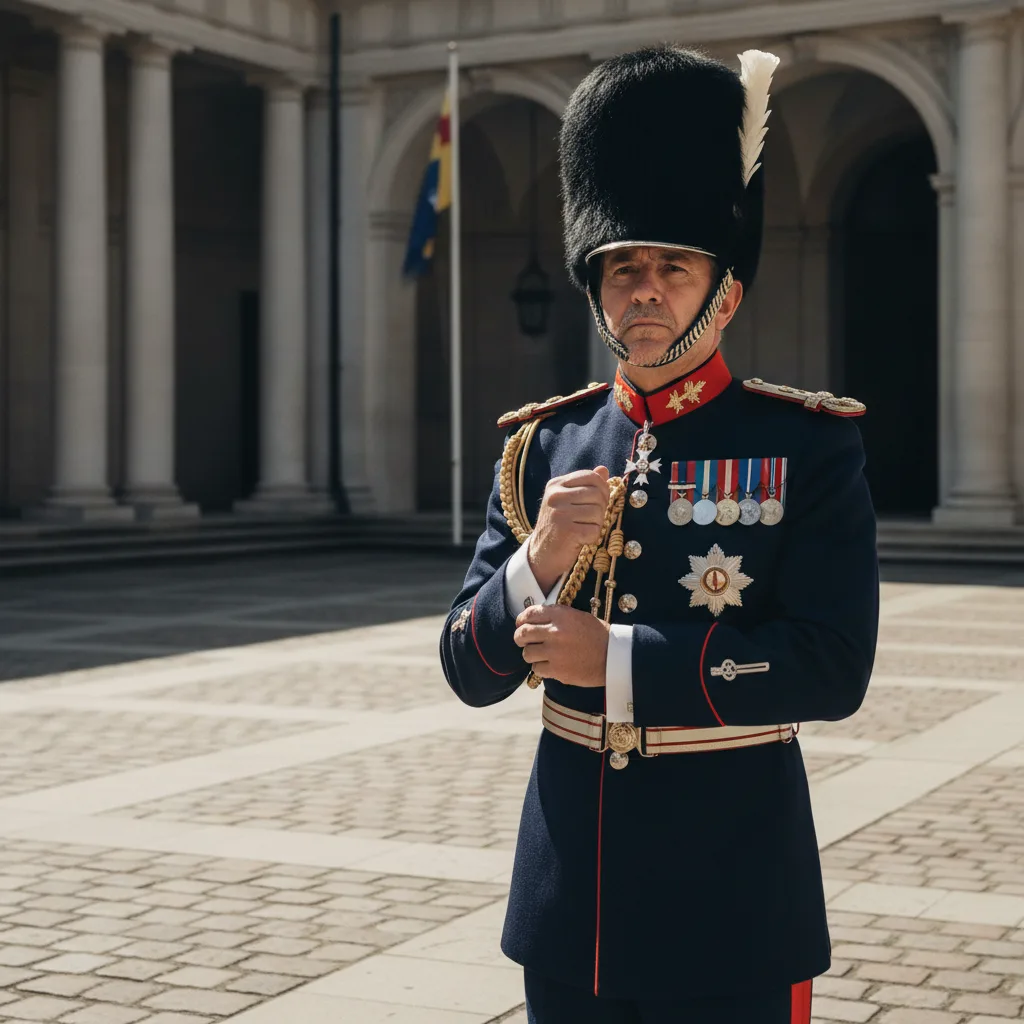
A military ceremony leaves nothing to chance. Every element of the dress follows a precise order, from the placing of medals to the cut of the jacket. Within such a tightly codified setting, one question comes up again and again among officers, reservists and civilian guests: do cufflinks have a place at a military ceremony, and if so, under what conditions?
At Une Autre Paire de Manches, we have been dressing shirt cuffs long enough to know that a poorly chosen accessory is noticed immediately at a parade. Here is what you need to understand before fastening your cuff.
Cufflinks for Military Ceremonies: The Complete Guide
Reading time: ~9 min
- Cufflinks and military ceremonies: what the regulations really say
- Ceremonial uniform or mess dress: two very different settings
- Which shirt to wear with cufflinks at a ceremony
- Gold, silver or steel: which finish to choose
- Regimental emblems and military insignia: where to draw the line
- Fastening, wear and care: losing nothing on parade
- Giving cufflinks to a member of the armed forces
- Going further with your ceremonial cufflinks
- Frequently asked questions
Cufflinks and military ceremonies: what the regulations really say
What military dress regulations provide for
The first rule to take on board is a simple one. On a uniform, aesthetics decide nothing. The applicable dress is defined by the instructions specific to the service, corps and unit concerned. The Instruction No. 20 on French military dress, published by the French Ministry of the Armed Forces, describes the patterns of ceremonial jackets, their colours, their rows of buttons and their regulatory features. In other words, the visible elements of a ceremonial uniform are governed with a precision that leaves no room for improvisation.
A common confusion also needs clearing up. Military texts regularly refer to jacket buttons, sleeve buttons or uniform buttons. These pieces are sewn or fixed onto the garment and follow the regulation pattern of the arm or corps. They have nothing to do with the shirt cufflink, a removable accessory designed to fasten a French cuff. A regulation sleeve button is not sold as a piece of wrist jewellery, and the reverse is just as true.
One last point, and it is crucial. The Official Bulletin of the Armed Forces states that decorations worn on uniform follow precise forms and positions, and that ribbons or rosettes in the buttonhole are reserved for civilian dress. By extension, a personal accessory must never imitate an official decoration, a rank insignia or a cross. A cufflink reproducing a medal on a uniform falls outside French military dress protocol and is as much a lapse of taste as a breach of regulations.
Important
With a regulation uniform, only accessories expressly authorised by the applicable ministerial instruction or by your unit's orders should be worn. If in doubt, ask your chain of command, never the seller.
Ceremonial uniform or mess dress: two very different settings
Telling ceremonial uniform and mess dress apart
Ceremonial uniform is institutional dress intended for parades, reviews and official commemorations. Jacket, shirt, tie, rank insignia, military decorations, headdress and shoes form a coherent whole that is not personalised. Protocol-driven restraint is the rule, and no accessory should disturb the visual order of the uniform, as the French military ceremonial guides issued by prefectures point out.
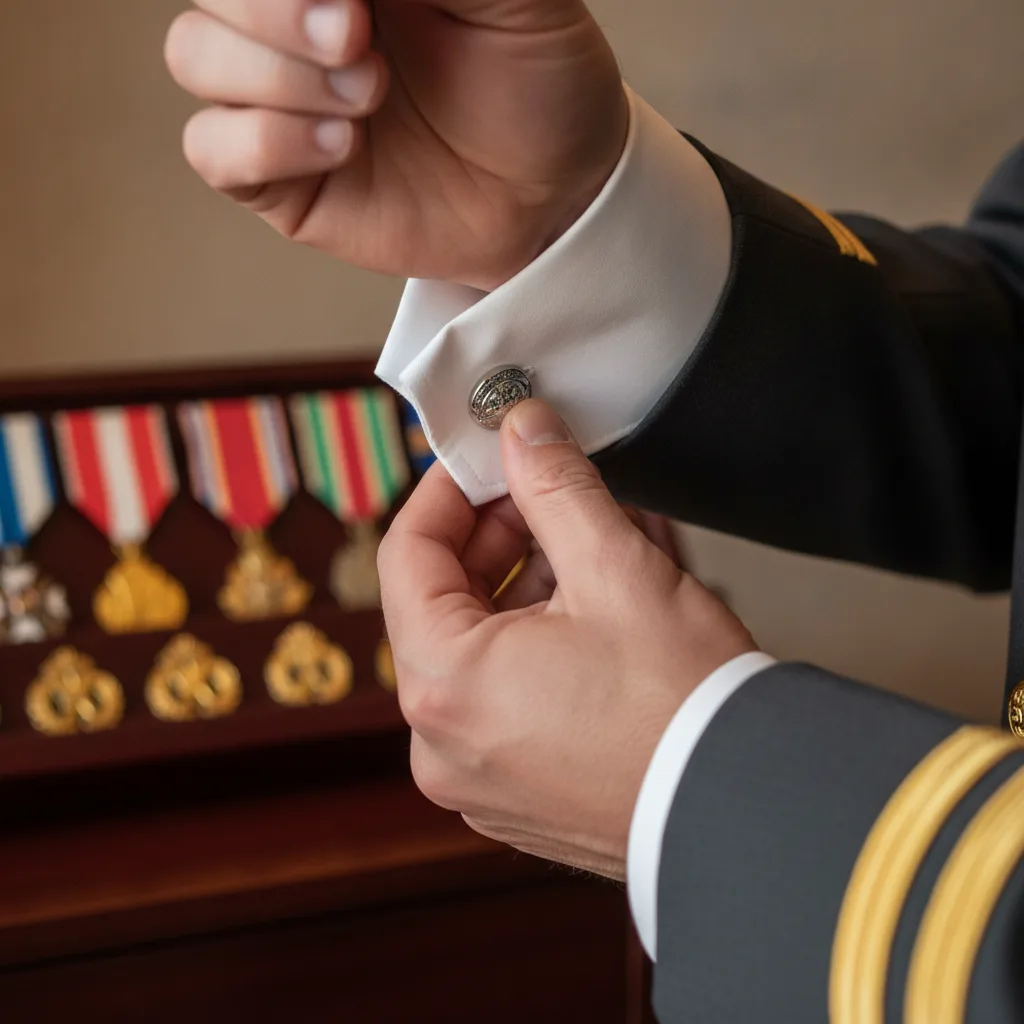
Mess dress follows a different logic. Closer to evening wear than to everyday service uniform, it traditionally leaves more room for formal accessories. The Canadian Armed Forces dress instructions, often cited as a point of comparison, explicitly provide for cufflinks with certain orders of mess dress: plain, gilt, or bearing the emblem of the service or regiment. Bear in mind, however, that this foreign reference does not automatically carry over to French regulations. It simply shows that mess dress is the military setting in which cufflinks are most likely to be accepted.
| Situation | Cufflinks | Recommendation |
|---|---|---|
| Regulation ceremonial uniform | Subject to regulations | Check the dress instruction and your unit's orders |
| Mess dress | Often possible | Follow the rules specific to the mess dress concerned |
| Civilian suit at a military event | Yes | Understated design, not mistakable for an official decoration |
| Civilian guest at a commemoration | Yes | Classic design, with no ambiguous military symbol |
| Military-themed family ceremony | Yes | Discreet motif, never an official insignia |
Which shirt to wear with cufflinks at a ceremony
Choosing a shirt suited to cufflinks
A cufflink only exists through the shirt that receives it. It needs French cuffs, also known as double cuffs. This cuff folds back on itself and is fastened solely by the accessory, with no sewn-on button. Specialists in men's jewellery point out that you should carefully line up the buttonholes of both layers of fabric before inserting the post, without ever forcing it.
For a ceremonial shirt with French cuffs, white remains the safe choice, followed by very pale blue. The fabric should be firm enough for the double cuff to hold its line through several hours of standing. Before buying, check the diameter of the buttonholes and the thickness of the cuff, because a post that is too short turns dressing in the morning into a test of nerves. A full trial run the day before the ceremony saves a good deal of aggravation.
Gold, silver or steel: which finish to choose
No metal colour is universally compulsory, and peremptory claims on the subject should be treated with caution. The guiding principle is consistency. A silver finish goes with a silver watch, belt buckle or waistcoat buttons. A gold finish makes sense with gold accessories and suits traditional dress or a very formal ceremony. Steel or dark finishes suit a contemporary civilian suit worn for a ceremony.
If in doubt with a dark suit, silver remains the most neutral and easiest choice to wear. Whatever the shade, opt for a small round or rectangular design in plain metal, with no garish stone or visible logo. A diameter of around 1.5 cm is a common commercial benchmark for a discreet design, as found at several French houses, although it is by no means a military standard. Our selection by shape and by colour will help you refine your choice.
Regimental emblems and military insignia: where to draw the line
Cufflinks bearing military insignia have a natural appeal, whether an anchor, a star, an eagle, a regimental crest or an arm-of-service emblem. Wearing them nonetheless calls for caution. With civilian dress, regimental cufflinks worn discreetly are an elegant tribute. On a uniform, they fall under dress regulations, and the fact that a design is on sale never means it has been officially approved.
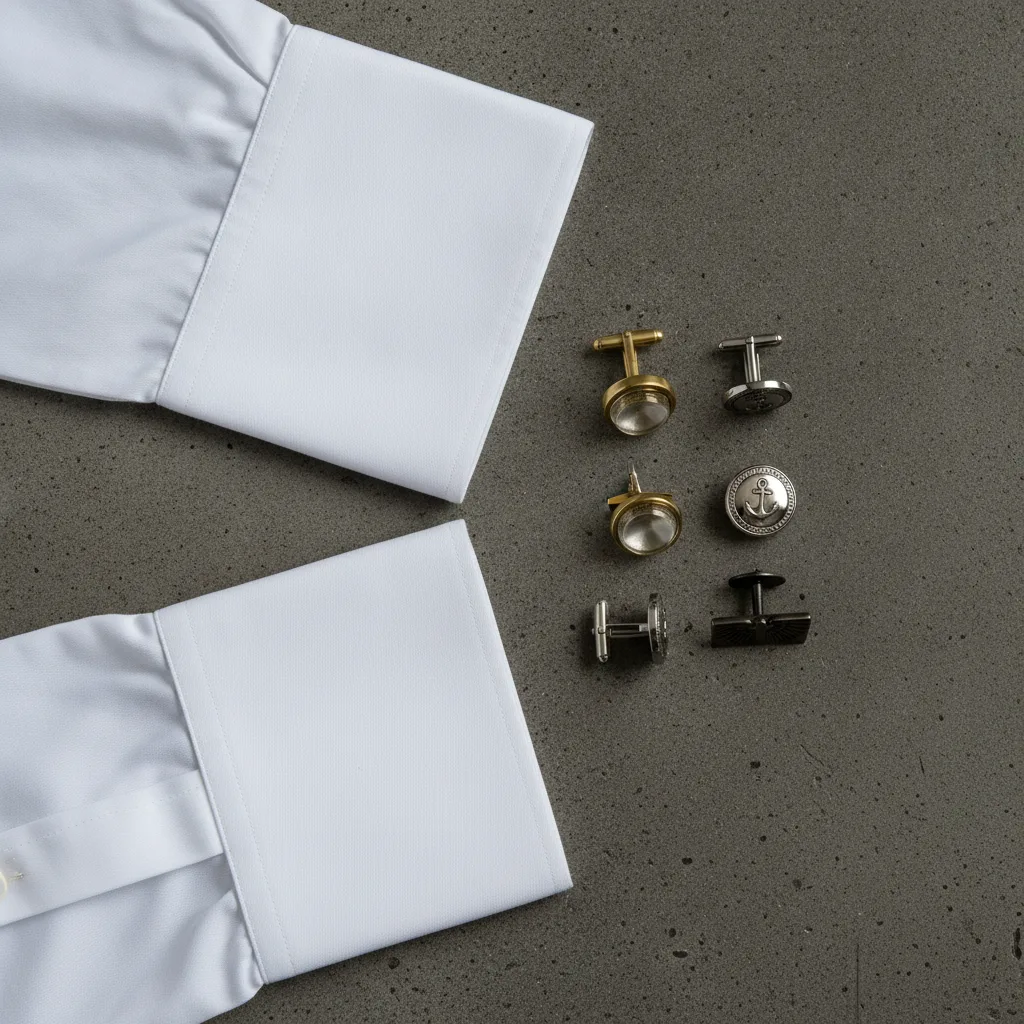
Three checks are essential before buying an emblem design for an officer or NCO. Here are the points to verify every time.
- The accuracy of the motif and the manufacturer's authorisation to reproduce the emblem.
- That there is no possible confusion with a rank insignia or an official decoration.
- A precise product description and its origin, to avoid the rough reproductions sold on general marketplaces.
Good to know
An officer's cufflink with a themed motif looks very good off duty, worn with a civilian suit. Our golf and Star Wars collections illustrate this idea of a confidently personal motif.
Fastening, wear and care: losing nothing on parade
Choosing a reliable fastening for the ceremony
A ceremony goes on, arms move, sleeves rub. The fastening therefore matters as much as the design. The swivel fastening, known as a bullet back, remains the most reliable for prolonged wear. The decorative face is joined to a post fitted with a small pivoting toggle that locks with a quarter turn, allowing quick insertion and a firm hold. Chain-link designs offer a more traditional look and pleasing flexibility at the wrist, but their hold is sometimes less secure. Woven fabric knots, more casual, are best kept for less formal settings.
To avoid mishaps, test the fastening on the shirt you will wear before the event, check that the post is not bent and that the hinge has no play, then swing the toggle fully into place once it is through. Carrying a spare pair in an inside pocket remains the simplest precaution. As for care, a soft cloth after each wear, no prolonged contact with water or perfume, and individual storage in a presentation box are enough to preserve the metal plating for several years.
Giving cufflinks to a member of the armed forces
Cufflinks make a remarkably good military gift for a medal presentation, a retirement or a promotion. The golden rule is to give something intended for civilian dress rather than an accessory meant to join the uniform. A plain design in silver or gold tone, of moderate size and presented in a box, will stay with the recipient long after the ceremony. Our gift sets are designed with this in mind, and our best sellers offer a good starting point.
Going further with your ceremonial cufflinks
In short, cufflinks for a military ceremony belong to two distinct worlds. On the uniform, the regulations decide, and they alone. On a civilian suit worn for an official commemoration, the accessory regains its full legitimacy, provided it stays understated, well proportioned and perfectly matched to the rest of the outfit. This discipline over detail is precisely what distinguishes a well-dressed man from a man who is merely clothed.
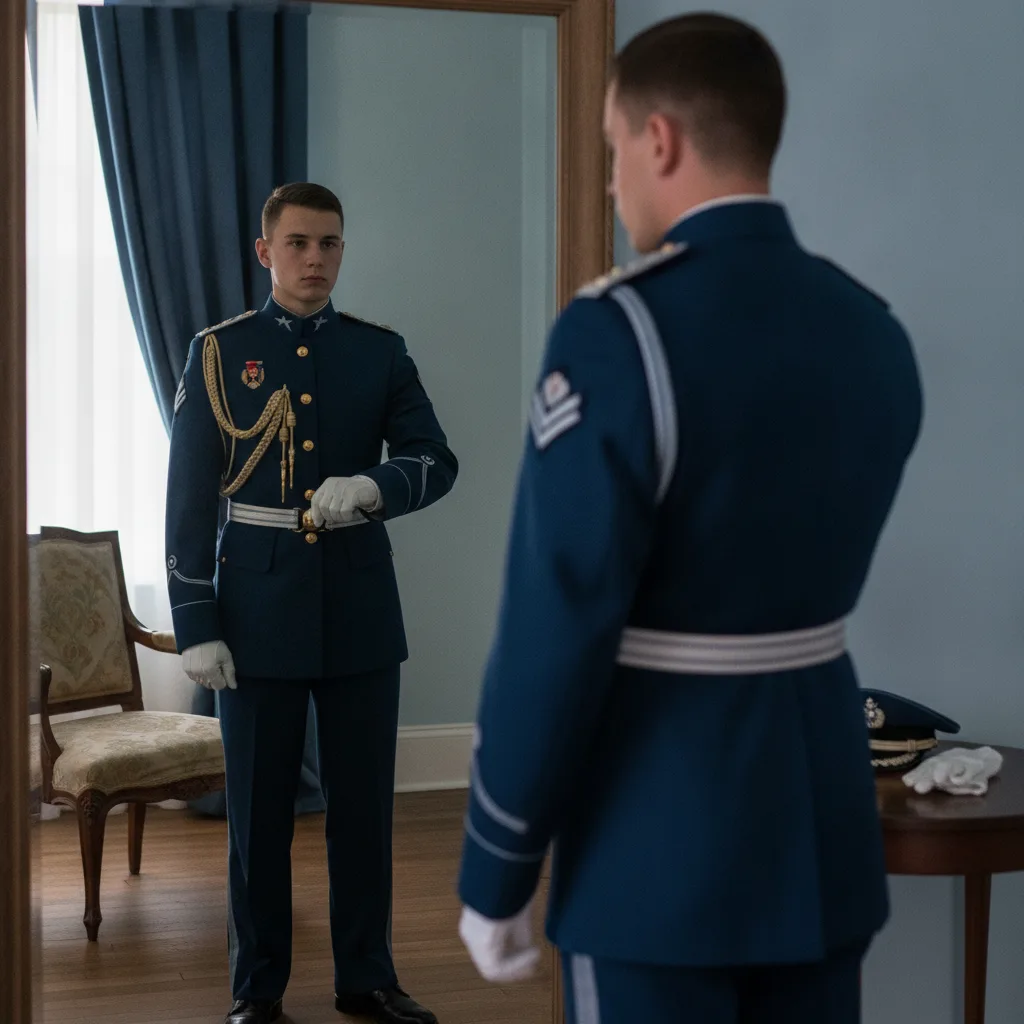
Final thoughts on cufflinks for military ceremonies
By keeping in mind the distinction between regulation uniform and civilian dress, along with the few pointers on choice set out above, you can wear or give cufflinks for a military ceremony with complete peace of mind, with no lapse of taste and no breach of protocol.
FAQ – military ceremony cufflinks
Can a reservist wear his own cufflinks on duty?
Reservist status does not change the rules applying to the dress being worn. Once the uniform is on, it is the orders of the unit of assignment and the ministerial instructions that apply, exactly as for a regular serviceman.
What if the uniform shirt does not have French cuffs?
Then the question answers itself. A single cuff with a sewn-on button cannot take a cufflink, and there is obviously no question of altering a regulation shirt to create one.
Can cufflinks be matched with a tie pin at a ceremony?
Yes, with civilian dress, provided you keep the same metal finish and comparable proportions. Two discreet pieces in the same metal are always better than an overloaded full set.
Are silk knot cufflinks suitable for an official event?
They bring colour and flexibility, which makes them better suited to receptions and dinners than to ceremonies governed by protocol. For a parade or a commemoration, plain metal remains more appropriate. Our range can be browsed among our silk knot designs.
How should you carry your cufflinks on the day of the ceremony?
In their box or in a small rigid pouch, toggles folded, never loose in a pocket. Metal gets scratched by keys and coins, and a hinge forced in a bag always gives way at the worst possible moment.