

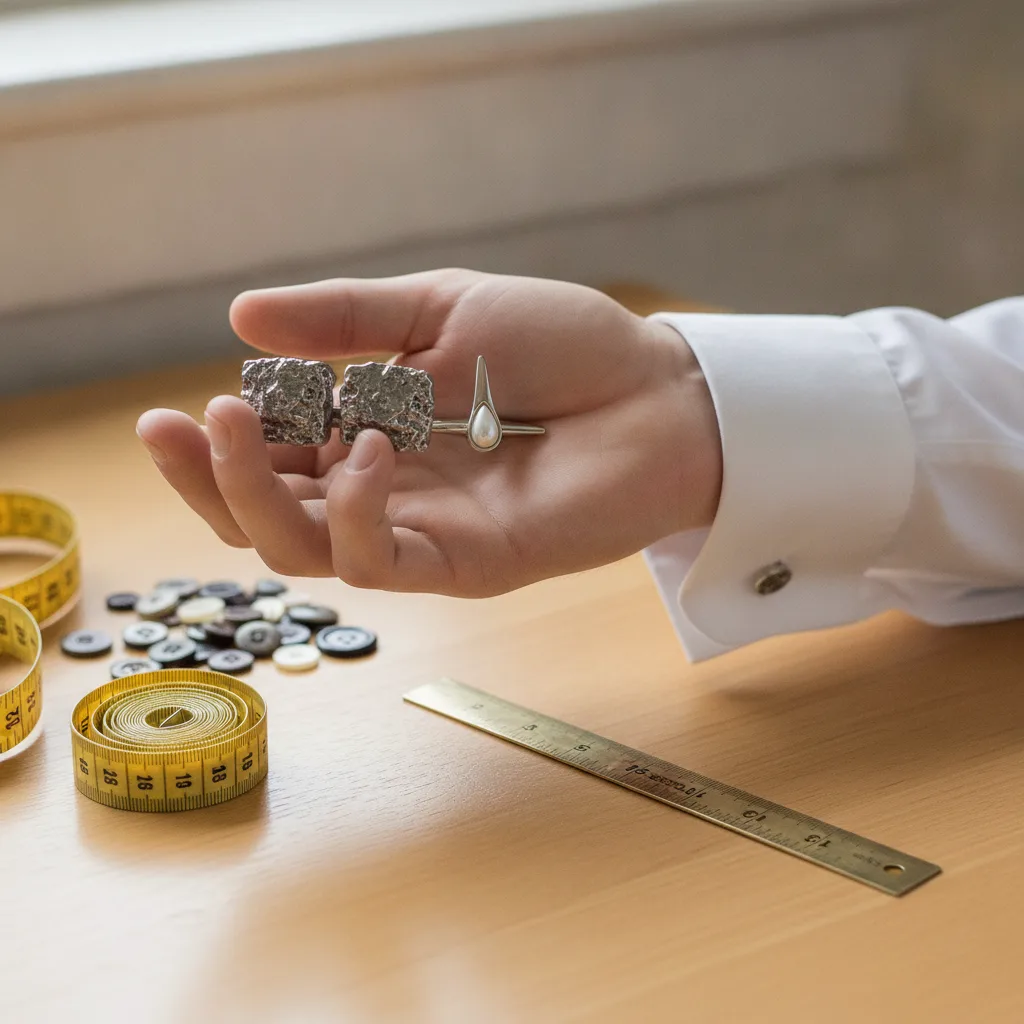
A slim wrist forgives no excess bulk. Where a broad wrist absorbs an imposing piece, a delicate frame turns the slightest extra millimetre into a visible imbalance. Choosing cufflinks for slim wrists is therefore less a matter of taste than of geometry, balancing the diameter of the cufflink, its footprint on the sleeve and the fit of the shirt cuff.
This guide gives you a simple measuring method, concrete size benchmarks and the mistakes to stop making. The goal: a harmony of proportions that gets noticed without ever taking over.
Cufflinks for slim wrists: a complete guide
Reading time: ~8 min
- Why proportion matters so much on a slim wrist
- How to measure your wrist before choosing
- What size of cufflinks for slim wrists
- Which shape suits a narrow wrist best
- Which shirt to choose for these cufflinks
- How to put them in properly without damaging the shirt
- Mistakes to avoid with a slim wrist
- Going further with well-suited cufflinks
- FAQ
Why proportion matters so much on a slim wrist
A cufflink is not a piece of jewellery in isolation: it is a visual anchor placed where the jacket sleeve, the folded cuff and the hand meet. On a slim build, the space available between the edge of the sleeve and the base of the thumb is limited.
An overly wide piece then spills beyond the face of the cuff, creates a sense of mass and draws the eye to the contrast between the accessory and the wrist rather than to the formal outfit as a whole.
Specialist houses and style guides agree on this principle. Retailers such as Suit Supply point out that a bold piece suits a broad wrist, while a delicate piece better complements a narrow one. Leading English-language menswear references, notably Art of Manliness, Real Men Real Style and Bespoke Unit, stress for their part that a shirt cuff should be fitted without being tight, an essential condition for keeping the accessory in line with the arm and stopping it from rotating.
Proportion between wrist and cufflink
Two notions that are often confused need to be distinguished. Wrist proportion refers to your circumference and the width of the cuff once fastened. Cufflink diameter, on the other hand, refers to the size of the face visible on the outside of the cuff. The same 20 mm cufflink will look balanced on a wide cuff and clearly oversized on a narrow one. It is the ratio between the two that creates, or fails to create, a successful visual proportion.
How to measure your wrist before choosing
Measuring takes two minutes and prevents most regrettable purchases. Take a soft tape measure, place it just above the wrist bone, exactly where the cuff sits, and close the tape without pulling it tight. Note the figure in centimetres. If you have no tape measure, a strip of paper then laid against a ruler gives a reliable result.
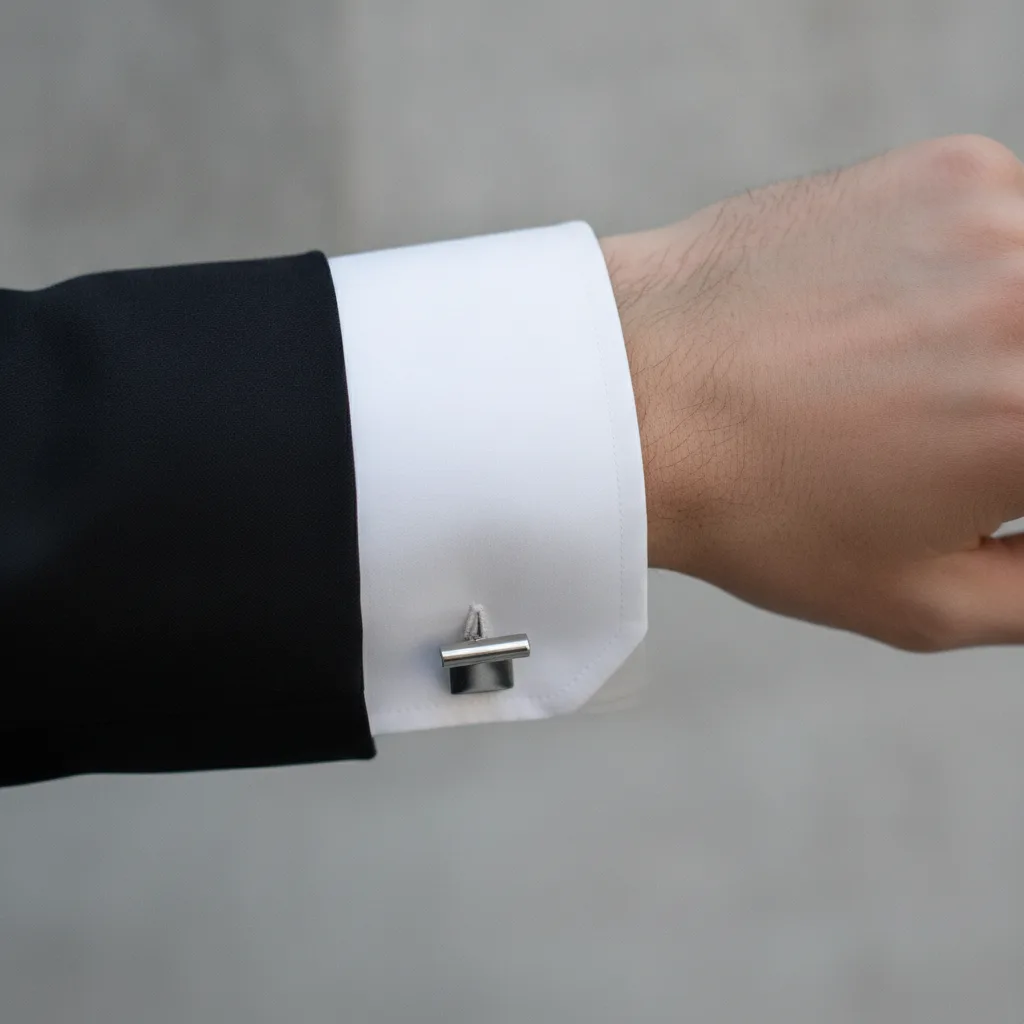
Next, measure the width of your fastened French cuff, that is, the height of fabric visible between the edge of the sleeve and the fold of the cuff. It is this second figure that really determines the size of the cufflink, because it defines the surface on which the piece sits. A narrow cuff calls for a compact format; a deeper cuff can take more material.
Key takeaway
A wrist circumference below roughly 16 cm is generally considered slim in sizing guides for bracelets and cuffs. Below that benchmark, always favour light, delicate pieces.
What size of cufflinks for slim wrists
There is no universal standard, and dimensions vary from one maker to another. Buying guides and specialist selections nevertheless steer slim builds towards small to medium formats, often between 12 and 18 mm of visible diameter for so-called delicate pieces. Beyond 20 mm, the sense of mass becomes hard to control on a narrow wrist, unless you deliberately opt for a confident statement piece.
Diameter benchmarks for slim wrists
Here is a quick reference for matching your measurement to the recommended size.
| Wrist circumference | Recommended visible diameter | Recommended style |
|---|---|---|
| Under 15 cm | 12 to 14 mm | Very discreet piece, satin finish, round or oval shape |
| 15 to 16.5 cm | 14 to 16 mm | Elegant compact format, rounded square, soft silk knot |
| 16.5 to 18 cm | 16 to 18 mm | Medium volume, slim rectangle, understated stone or enamel |
| Over 18 cm | 18 mm and above | Bolder piece, strong geometric shapes |
These figures are benchmarks for balance with your build, not rigid rules. If you are torn between two sizes, go down one. A cufflink that is slightly too small goes unnoticed; one that is too big is obvious immediately.
Which shape suits a narrow wrist best
Shapes suited to slim wrists
Shape influences the perception of volume as much as diameter does. A round design occupies a continuous surface and looks more generous than its actual measurement, though it still reads very well on a slim wrist as long as it stays small. A square or rectangular design, set along the line of the sleeve, visually lengthens the wrist and sharpens the silhouette, provided the corners are slightly softened.
For cufflinks intended for small wrists, three families work particularly well. Oval and teardrop shapes follow the natural curve of the wrist. Slim rectangular formats create a vertical line that makes the arm look even more slender. Silk knots, those soft cufflinks made of braided thread, almost entirely remove rigid bulk and are an excellent starting point for delicate builds, as you can see in our selection of silk knots. To explore the other geometries available, our catalogue is organised by shape.
Weight and fastening systems
Weight and the fastening mechanism matter too. A toggle system, the most common, stays flat and stable. A rotating system holds very securely but sometimes adds thickness to the back of the cuff. A rigid chain fastening spreads the load better on delicate pieces. Stainless steel and satin finishes, less reflective than a mirror polish, reduce the perception of volume still further.
Which shirt to choose for these cufflinks
No cufflink will rescue a badly cut cuff. Cufflinks are worn on a shirt with a French cuff, also called a double cuff, whose fabric folds back on itself to create overlapping buttonholes.
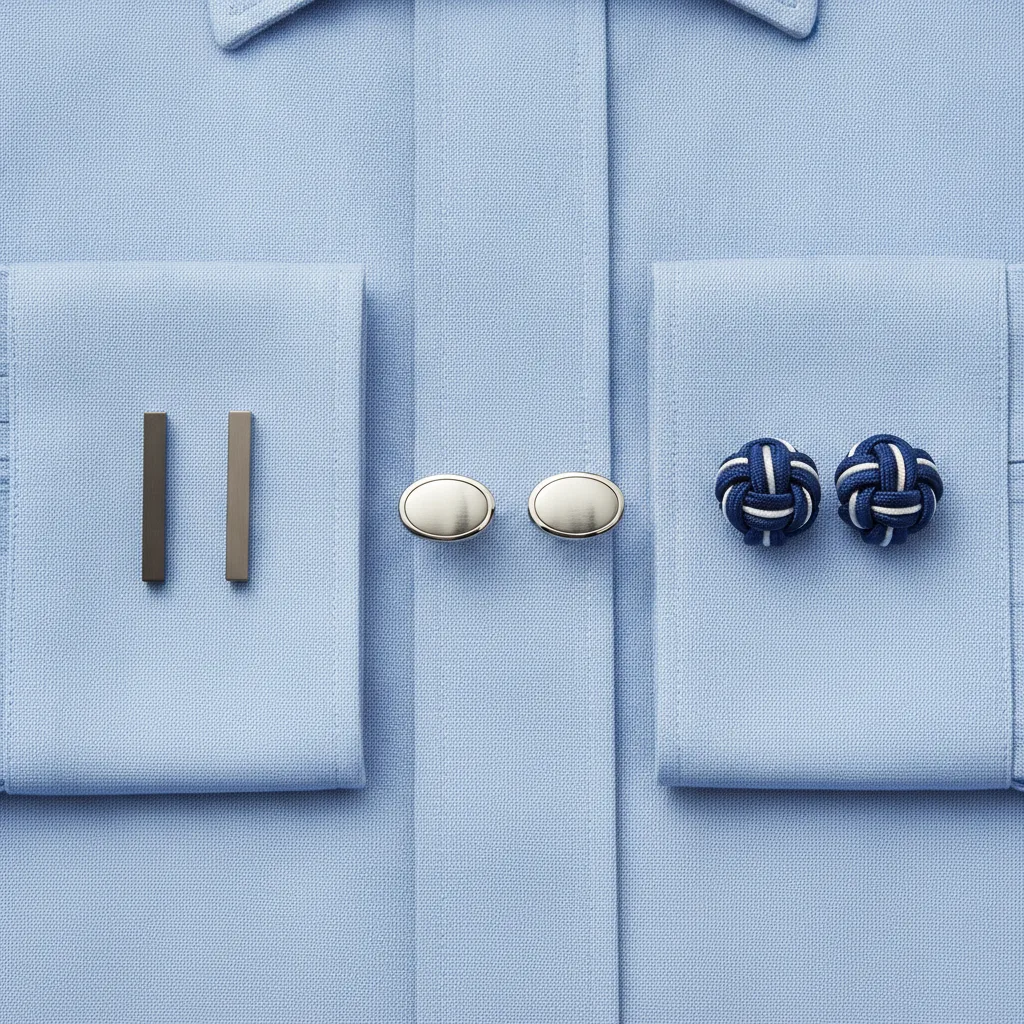
On a slim build, look for a fitted cut with a cuff of moderate depth that does not spin around the arm and lets about one centimetre of shirt show beneath the jacket sleeve.
Sleeve length plays a decisive role. Too long, and the cuff slides over the hand and exaggerates the size of the cufflink. Too short, and it exposes too wide an area of fabric. French shirtmakers such as Café Coton offer slim-fit French cuffs that suit narrow wrists well. If the cuff is still too loose, an alterations tailor can take it in by a few millimetres at modest cost.
Good to know
The French-cuff shirt is not just for weddings. On a sober business shirt, a compact suit accessory works very well at the office, as long as you stick to matt finishes and neutral colours.
How to put them in properly without damaging the shirt
The method is always the same. Fold the cuff back on itself so that the two buttonholes overlap, line up the openings carefully, then insert the cufflink from the outside in, with the face showing on top. Then flip the fastening to lock the piece in place. Never force it: a new buttonhole loosens after a few wears, and pushing too hard weakens the fabric for good.
Roughly aligned buttonholes are enough to make the cufflink rotate and sit visibly askew on a slim wrist. Get into the habit of checking it is straight after putting on your jacket, as arm movement often shifts the cuff.
Mistakes to avoid with a slim wrist
Certain habits ruin the balance you are after, even with a beautiful piece. Here are the most common ones we see among our customers.
- Choosing a diameter above 20 mm in the belief that the accessory must be visible from afar
- Wearing an overly loose cuff that lets the cufflink spin around the wrist
- Pairing a very shiny piece with a large watch, which overloads the wrist area
- Neglecting the jacket sleeve length, which should give the cuff room to breathe
- Stacking a bracelet, a chunky watch and a bulky cufflink on the same arm
Simply by applying these benchmarks, you achieve a coherent outfit in which the accessory serves the silhouette instead of competing with it. At Une Autre Paire de Manches, our themed collections such as golf or Star Wars also include compact designs; check the dimensions on each product page so that a piece's character never comes at the cost of bulk.
Going further with well-suited cufflinks
Choosing cufflinks for slim wrists means thinking in terms of proportions rather than isolated crushes. Measure your wrist and your cuff, aim for a diameter between 12 and 18 mm, favour elongated or soft shapes, and check that your shirt fits in the right places. The rest is the pleasure of detail.

To get started, our most popular designs are gathered in our best sellers, and the latest additions in our new arrivals.
The key points for well-proportioned cufflinks
On a slim wrist, balance comes down to a few millimetres. By cross-referencing your wrist measurement with the depth of your cuff, then sticking to compact 12 to 18 mm formats with discreet or elongated shapes, you have already got the essentials right.
All that remains is to take care over the shirt (a well-fitted French cuff), how you put the cufflinks in and how you pair them with your watch and any bracelets, so that your cufflinks complement your silhouette without ever overwhelming it.
FAQ
Can you wear cufflinks with a single-cuff shirt?
No, a standard buttonhole is not designed to take this kind of fastening. There are adaptors that turn a button cuff into a French cuff, but the result remains approximate and adds unwelcome thickness on a slim wrist.
Is a gift set a good choice for getting started with a slim build?
Yes, as long as you check the dimensions of each pair. A gift set lets you try several shapes and finishes without multiplying purchases, and our assortments are grouped together in our selection of gift sets.
Does the colour of the metal change how big a piece looks?
Yes. A light, highly polished metal reflects more light and looks larger than a satin finish or a dark tone. On a narrow wrist, matt shades and deep enamels visually compact the piece, as our ranges sorted by colour show.
Should you adapt your choice to the shirt fabric?
A fine poplin holds the cuff less firmly than a twill or an Oxford. On lightweight fabrics, a heavy cufflink pulls the fabric downwards, which accentuates the imbalance. In that case, favour very light designs or silk knots.
How do you care for small, delicate pieces?
Wipe the face with a soft cloth after each wear to remove traces of sweat, and store each pair separately to avoid micro-scratches. Toggle mechanisms like to be moved through their full range, rather than being left halfway.
What if I want a striking accessory despite a slim wrist?
Play on pattern and colour rather than size. A 14 mm piece with a bold motif catches the eye without creating excess bulk, and our sale section is often a good way to try this kind of bold choice for less.