

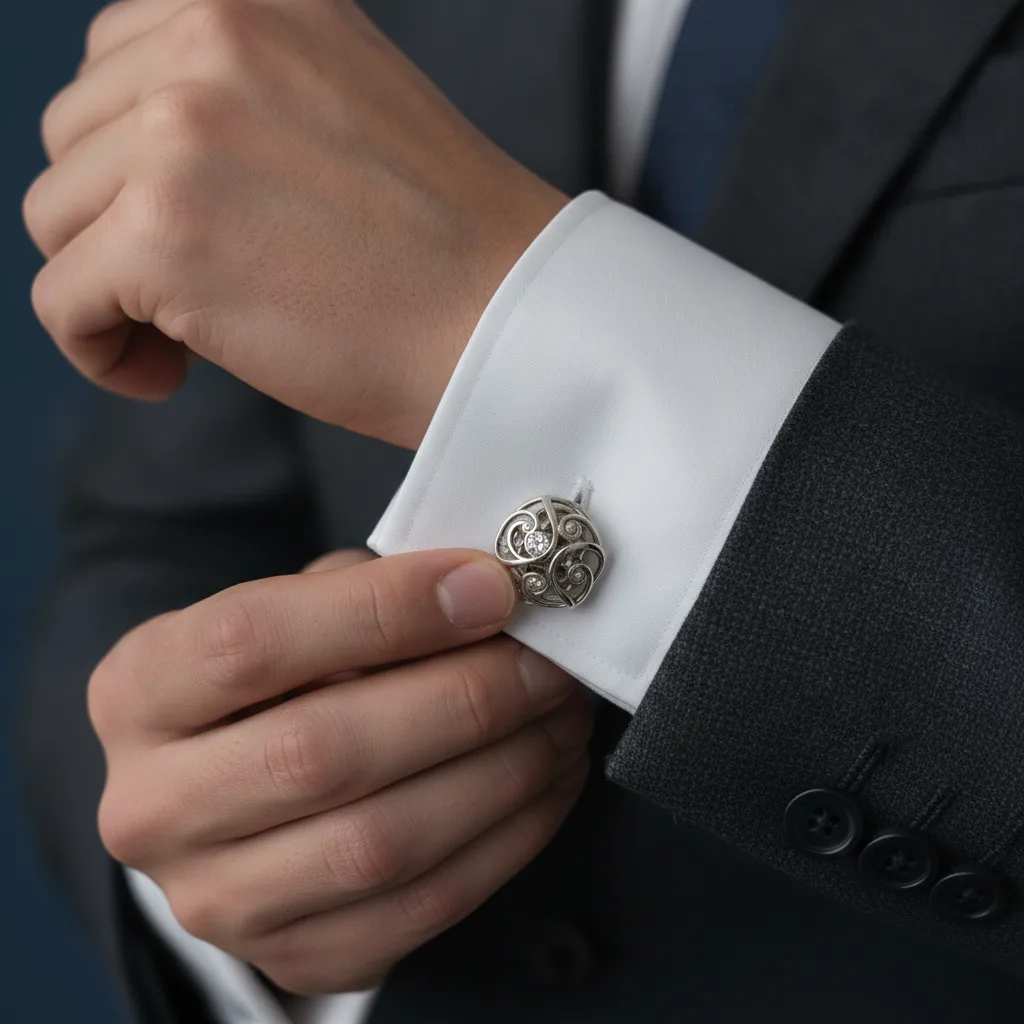
The French cuff shirt, also known as the double-cuff shirt, is one of those details that separate a decent outfit from a truly polished one. You can recognise it by its longer cuff, folded back on itself, which is fastened not with a sewn-on button but with a pair of cufflinks.
At Une Autre Paire de Manches, we receive questions about this garment every week, often from men who have just bought their first pair of cufflinks and discover they lack the right shirt. This guide covers everything you need to know before investing, from choosing the fabric to caring for it, including the occasions when this cuff is truly the right choice.
The French cuff shirt: the complete guide
Reading time: ~9 min
- What is a French cuff shirt?
- An origin linked to the King's Musketeers
- French cuff vs single cuff: the real differences
- When should you wear a shirt with French cuffs?
- How do you fasten a French cuff?
- Which cufflinks should you choose with a French cuff shirt?
- How to choose your French cuff shirt
- How do you look after a shirt with French cuffs?
- Can you wear it without a tie?
- Going further with the French cuff shirt
- Frequently asked questions
What is a French cuff shirt?
The French cuff, called the "poignet mousquetaire" (musketeer cuff) in France, is a turned-back cuff. In practice, the fabric at the end of the sleeve is about twice as long as a standard cuff. It folds back on itself, creating a clean turn-back and greater stiffness, then fastens through aligned buttonholes that take a cufflink.
It is precisely this absence of a sewn-on button that defines the garment: it can only be fastened with an accessory. It is also called a double-cuff shirt, since the fabric is indeed doubled across the whole width of the cuff.
This construction is not merely aesthetic. Folding the fabric gives the cuff more body, helps it sit better on the hand and keeps its shape all day, provided it is carefully ironed. This is one of the reasons why this cuff is regularly presented in specialist guides as the dressiest of all, ahead of the single cuff and the barrel cuff.
An origin linked to the King's Musketeers
The French name refers to the King's Musketeers (Mousquetaires du Roi), whose shirts had long, stiff cuffs that extended beyond the sleeve of the doublet. This historical lineage explains why the garment remains associated with tradition, panache and masculine elegance.
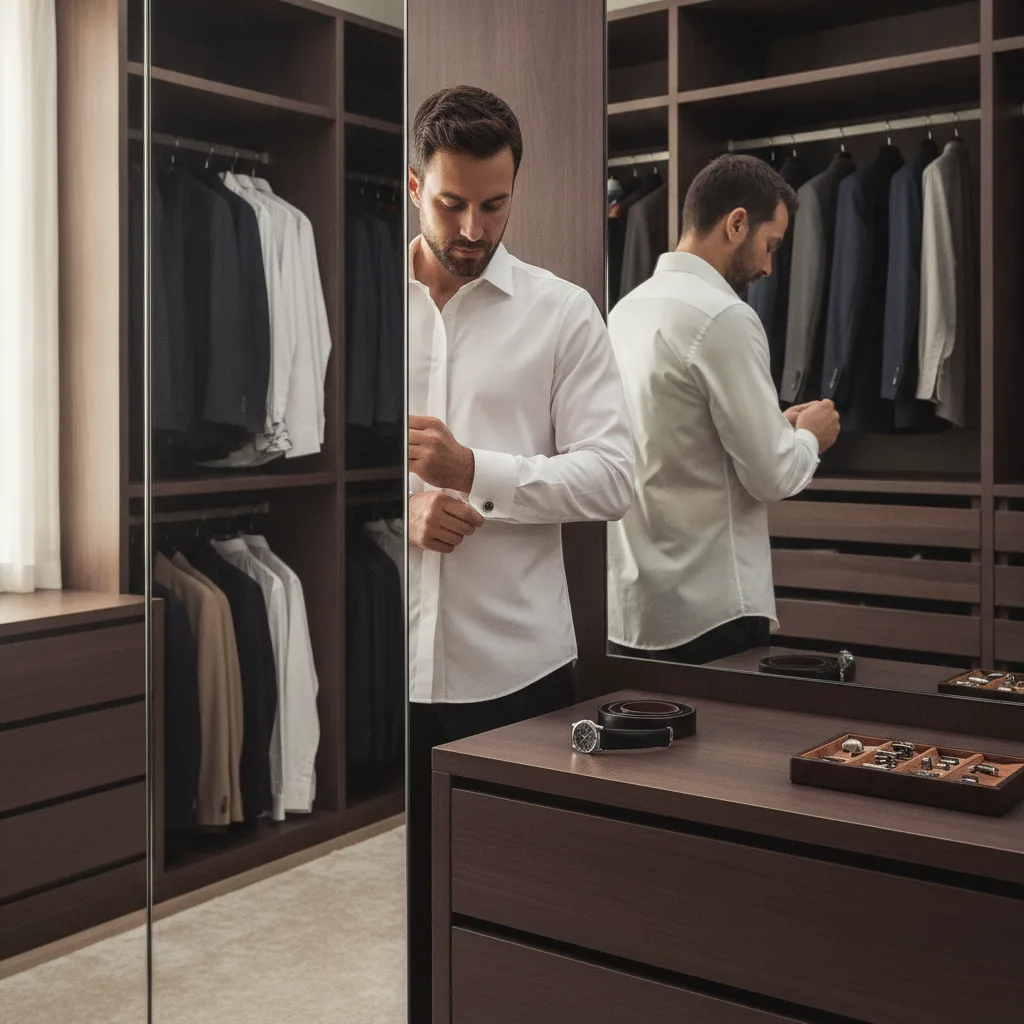
Shirtmakers and online encyclopaedias agree on this etymology, even if the modern, more understated cut has little left in common with the seventeenth-century garment. What remains is the idea of a visible cuff, worn with confidence and designed to be noticed.
French cuff vs single cuff: the real differences
The question comes up every time, because both cuffs can be worn with a suit. Yet the difference in effect is clear, and it comes down as much to the fastening as to the overall impression of the dressed silhouette.
| Criterion | French cuff | Single cuff |
|---|---|---|
| Fastening | Cufflinks required | Button sewn onto the cuff |
| Construction | Folded fabric, double cuff | A single layer of fabric |
| Level of formality | Ceremonies, dinner suit, formal business | From the office to smart casual |
| Stiffness and hold | High, the turn-back structures the end of the sleeve | Varies with the fabric and interlining |
| Typical occasions | Wedding, gala, important meeting | Everyday wear |
| Care | Demanding ironing, delicate washing | Standard care |
In short, the single cuff is versatile, the French cuff is specialised. The first goes unnoticed, the second gets seen. If you are looking for an all-purpose shirt, stick with the classic cuff. If you want to show off your accessories and give an outfit a signature, the French cuff is the right answer.
When should you wear a shirt with French cuffs?
For weddings and ceremonies
This shirt's natural territory remains the formal occasion. A wedding, an awards ceremony, a gala dinner, an evening in a dinner suit or tails all call for a formal shirt, often white, sometimes with a wing collar. The French cuff shirt for a wedding has even become almost a convention for the groom and his best men, as it allows the cufflinks to be matched to the other details of the outfit.
In a formal business setting
The second use, more of an everyday one for some, is formal business wear. With a dark suit, for a decisive meeting or a public speech, the French cuff adds a layer of seriousness with no extra effort.
For a well-judged semi-formal style
Finally, there is a semi-formal use, notably under a double-breasted jacket or a well-cut blazer, but it remains a minority choice and requires real consistency in the rest of the outfit. Wearing a French cuff shirt with jeans and trainers creates a mismatch that few silhouettes can carry off.
Good to know
The most useful rule of proportion remains how much cuff shows. The cuff should appear about one to two centimetres below the jacket sleeve, enough for the cufflinks to be seen, but never so much that it covers half the hand.
How do you fasten a French cuff?
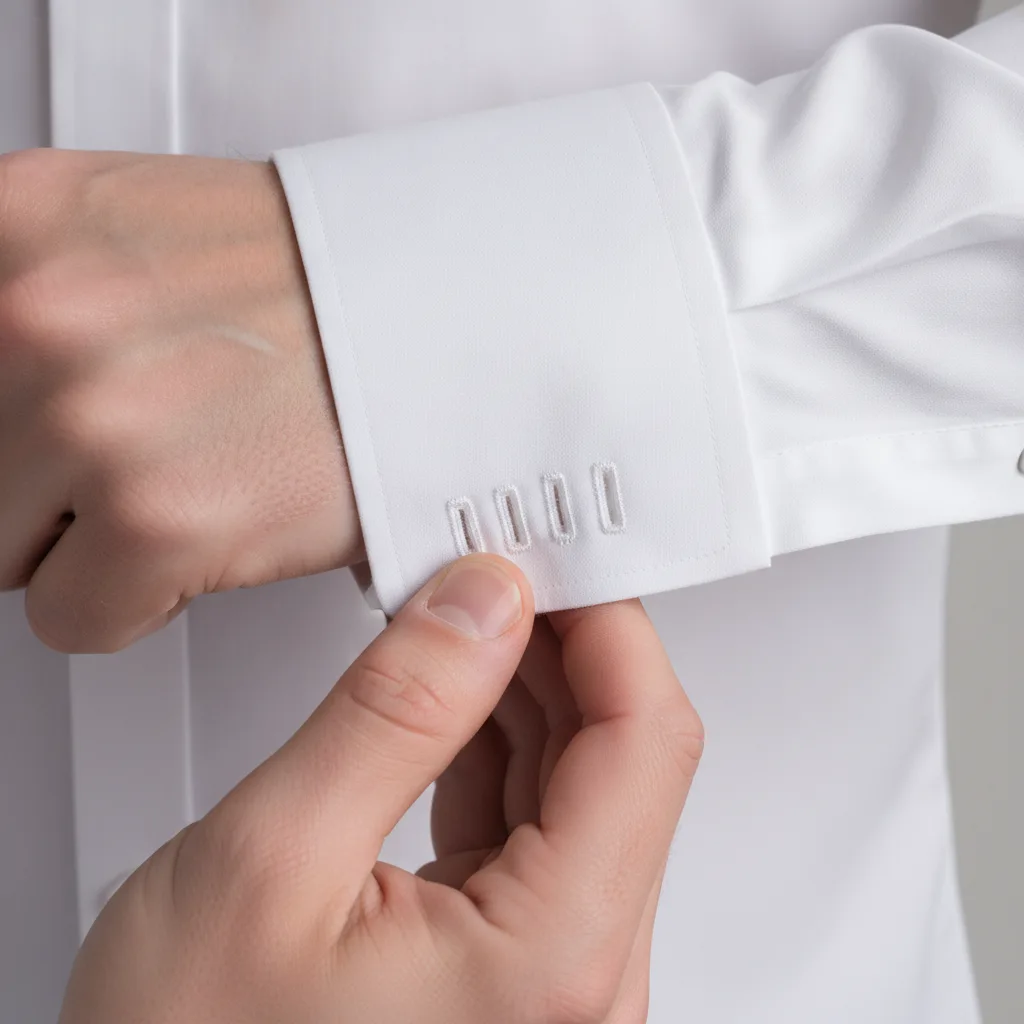
The process is surprising the first time, but it takes only a few seconds once mastered. First fold the cuff outwards along the fold line so that the turn-back appears. Then line up the four buttonholes, two on each side, bringing the two ends together face to face rather than overlapping them as you would with a standard cuff. Finally, insert the cufflink through all four layers and lock the mechanism, whether it is a swivel bar, a chain or a link.
One technical point is often overlooked: the two sides must meet edge to edge. A cuff fastened with an overlap forms an unsightly fold and strains the fabric around the buttonholes. Shirtmaking guides insist on this alignment, because it is what gives the sought-after square, clean finish.
Which cufflinks should you choose with a French cuff shirt?
This is where the personality of the outfit comes into play. The choice depends first on the level of formality of the event, then on the colour of the metals you are already wearing: belt buckle, watch, spectacle frames. Here are the main families to know to avoid lapses in taste.
Matching your cufflinks to the event
- For a classic ceremony or a wedding, favour understated cufflinks in polished metal, mother-of-pearl or plain enamel, which complement the shirt without stealing the show. Our designs can be browsed by shape and by colour.
- For business wear or a more relaxed evening, patterned, themed or colourful designs work very well, provided they remain the outfit's only focal point. Our most consistent sellers are gathered in our best sellers.
With a dinner suit, tradition calls for discreet cufflinks, ideally matching the shirt studs. Braided silk knots are a soft, lightweight alternative, particularly pleasant in summer and on fine shirts.
How to choose your French cuff shirt
Fabric and colour of the French cuff shirt
Four criteria determine a successful purchase. First the fabric: poplin for a smooth, slightly lustrous finish suited to ceremonies, and twill for a denser hand and softer drape. Then the colour: the white French cuff shirt remains the absolute benchmark for formal wear, with sky blue offering a credible alternative in a business setting.
Cut, sleeve and cuff circumference
The cut matters just as much. The sleeve should be fitted along the forearm, otherwise the fabric balloons above the cuff and ruins the intended effect. Finally, check the cuff circumference: once fastened, it should let your hand pass through without forcing, while staying close enough to the wrist not to slide over the hand when you lower your arm. A cuff that is too wide is the most common flaw on entry-level shirts.
One last technical detail deserves your attention: the distance between the buttonholes and the edge of the cuff. The shorter it is, the closer the cufflink will sit against the hand and the more visible it will be. The leading names in formal shirtmaking pay particular attention to this point.
How do you look after a shirt with French cuffs?
Washing and drying a French cuff shirt
Gentle fabric care determines how long the garment lasts. Wash the shirt inside out on a gentle cycle, with a detergent suited to fine fabrics. Avoid a harsh spin, which sets creases in the wrong places and strains the buttonholes. Ideally, dry it on a hanger with the collar buttoned, to reduce the ironing required.
Ironing and storage
Ironing the cuff calls for a method. Open the cuff out completely flat, iron the inside then the outside, and press the fold only at the very end, with the tip of the iron, to obtain a crisp edge. A cuff with a limp or uneven turn-back cancels out all the aesthetic benefit of the shirt. Then store your cufflinks in a dedicated case, which our gift sets are ideal for.
Key takeaway
Never lend a French cuff shirt with its cufflinks still in place: the mechanism loosens and the buttonholes stretch with repeated hasty handling.
Can you wear it without a tie?
No tie, but with a jacket
Yes, provided you accept the contrast. Without a tie and with an open collar, the French cuff shirt creates a dressy but less formal look, popular in creative circles and for relaxed evening outfits. The rule then is to choose slightly more expressive cufflinks, since they become the only visible accessory on the upper body.

No tie and no jacket
On the other hand, going without a jacket rarely works, as the cuff needs a jacket sleeve to frame it visually.
Going further with the French cuff shirt
The French cuff shirt is not a ceremonial gimmick; it is a canvas. It exists to showcase cufflinks and turn a functional detail into a personal signature. Well chosen, well fitted and well cared for, it will accompany you from weddings to your most important appointments for years.
The rest depends on your accessories, and that is where things get interesting. Our latest designs can be viewed online, along with current offers.
FAQ – Frequently asked questions
Is there such a thing as a short-sleeved French cuff shirt?
No, and that makes sense. The French cuff relies on a folded turn-back designed to show beyond a jacket sleeve. On a short sleeve, neither the function nor the proportion holds up, and no serious shirtmaker offers one.
Can a single-cuff shirt be converted into a French cuff?
An experienced alterations tailor can sometimes do it, but there needs to be enough fabric in the sleeve to create the turn-back, which is rarely the case on a mass-produced shirt. The cost of the work often exceeds the price of an entry-level French cuff shirt.
Do you need a different size from your usual shirt?
No, the collar size and sleeve length stay the same. Only the cuff circumference is worth checking, as it varies more from one brand to another on this type of construction.
What is the difference between a square and a rounded French cuff?
It is about how the corners of the turn-back are cut. The square cut gives a graphic, very formal look, while the rounded cut softens the line yet remains perfectly suited to ceremonies. Both are considered dressy options.
How many French cuff shirts should you have in your wardrobe?
Two are enough in most cases: a white one for ceremonies and a light blue or subtly patterned one for business. Beyond that, the investment is mainly justified if your job requires formal dress every day.
Conclusion on the French cuff shirt
The French cuff shirt remains a formal garment, designed to show off cufflinks and highlight the care taken over an outfit. By choosing a good fabric, a suitable cut and accessories in keeping with the occasion, you get a long-lasting shirt that will serve you equally well at grand ceremonies and at your most important business meetings.