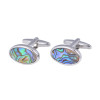
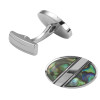
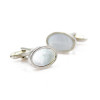
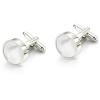
Jewellery-making is a craft defined by the richness of the materials used to create objects of art and adornment. Among them, mother-of-pearl is an organic material that has been used for centuries to embellish jewellery and accessories, thanks to its unique beauty. In this article, we look at what mother-of-pearl is, where it comes from, what makes it special and how it is used in jewellery to create exquisite, refined pieces.
What is mother-of-pearl?
Mother-of-pearl, also known as nacre, is an organic substance produced by certain molluscs, mainly oysters and mussels, in response to a foreign body entering their shell. It is made up of microscopic layers of aragonite, a crystallised form of calcium carbonate, alternating with layers of conchiolin, a protein that acts as a binder. This blend of hard and soft materials gives mother-of-pearl both its iridescent lustre and its strength.
How does mother-of-pearl form?
Mother-of-pearl forms inside the shells of these bivalve molluscs, chiefly pearl oysters and freshwater mussels. When a foreign body, such as a grain of sand or a parasite, gets inside the shell, the mollusc secretes layers of nacre around the irritant to neutralise it and protect itself. Over time, these layers build up to form a pearl, or a pearly lining on the inside of the shell.
What are the characteristics and properties of mother-of-pearl?
Several qualities make mother-of-pearl so appealing for jewellery:
- Iridescence: mother-of-pearl has a natural iridescence, the result of light being refracted and diffracted through its layers of aragonite and conchiolin. This creates a play of colour that shifts with the viewing angle, giving the material its unique, precious look.
- Strength: despite its organic make-up, mother-of-pearl is tough and durable. The combination of hard aragonite and flexible conchiolin allows it to withstand pressure and knocks without breaking.
- A variety of colours and patterns: mother-of-pearl comes in a wide range of colours, from white to pink, by way of grey and black. Its natural patterns also vary from one piece to the next, adding to its charm and individuality.
- Biocompatibility: mother-of-pearl is biocompatible, meaning it is generally well tolerated by the skin and does not cause irritation or allergies. That makes it a safe, comfortable choice for jewellery, especially earrings and pendants worn directly against the skin.
The history of mother-of-pearl in jewellery
The use of mother-of-pearl in jewellery goes back several thousand years. Mother-of-pearl objects and jewellery have been found at archaeological sites dating from antiquity, notably in Egypt, Mesopotamia, China and Central America. These ancient civilisations prized it for its natural beauty and its supposed protective powers.
How techniques and styles evolved
Over time, craftsmen developed a range of techniques for working mother-of-pearl into their creations, including carving, engraving, inlay and marquetry. These advances made it possible to produce ever more elaborate and refined jewellery and objets d'art.
Over the centuries, styles and trends in mother-of-pearl jewellery have changed with cultural tastes. During the Art Nouveau period, for example, it was often used to create jewellery with floral and organic motifs.
Mother-of-pearl in different cultures and traditions
Mother-of-pearl has been, and still is, used in many cultures to create jewellery and artefacts with cultural or religious meaning. In Māori culture in New Zealand, for instance, it is used for ornaments and jewellery such as the hei matau pendant, which represents strength and determination and is believed to bring prosperity and safe passage on sea voyages.
In Japan, mother-of-pearl is used in a craft technique called raden, in which thin slivers of shell are inlaid into wood or lacquer to create intricate, luminous patterns. The technique is often used to decorate jewellery boxes, musical instruments, furniture and other works of art.
In short, mother-of-pearl is a material as fascinating as it is versatile. Its iridescent beauty and unique properties have enchanted ancient and modern civilisations alike, giving rise to countless jewellery creations.